



B2B Content SEO: The Complete Playbook for 2026
Table of content
Most B2B content programs generate traffic. The best ones generate pipeline. The difference is not publishing frequency or word count. It is whether the content is built on a coherent keyword architecture, structured for topical authority, and optimized for the surfaces where B2B buyers actually find answers in 2026: Google organic, AI Overviews, and large language model search tools.
This playbook covers the complete B2B content SEO strategy from keyword mapping through pipeline attribution. It is written for marketing directors and content teams who already publish consistently and want to turn that effort into a compounding organic channel. If you are also building the technical foundation alongside content, the B2B technical SEO guide covers the infrastructure layer this content strategy depends on.
What Makes B2B Content SEO Different from B2C
B2B and B2C content SEO share the same underlying mechanics: keyword research, on-page optimization, authority signals. What differs fundamentally is the buying context your content needs to serve.
The Multi-Stakeholder Buying Committee
A B2B software purchase commonly involves 6 to 10 decision-makers: an end user, a technical evaluator, a finance approver, a procurement lead, and an executive sponsor. Each persona searches for different things, uses different terminology, and needs content at a different depth. B2B content SEO must map content to persona, not just to intent stage. A single pillar post cannot serve all of these roles simultaneously.
- End users search for how-to and implementation guides: “how to set up [tool] for B2B lead management”
- Technical evaluators search for integration, security, and API documentation: “[tool] API documentation,” “[tool] SSO setup”
- Finance and procurement search for pricing, ROI benchmarks, and case studies: “[tool] pricing,” “[tool] ROI calculator”
- Executive sponsors search for category validation and competitive landscape: “best B2B [category] software,” “[vendor] vs [vendor]”
Buying Cycles, Intent Volume, and Conversion Chains
B2B buyers research a category for months before contacting a vendor. Content that captures early-stage research queries, educates through the evaluation phase, and addresses final-stage objections is the full content SEO job. A single pillar post or product page is not sufficient.
- 6 to 12-month evaluation timelines. Content must work at every stage of a long research cycle, not just at a single point.
- Low search volume, high intent. B2B keyword phrases like “enterprise CRM for manufacturing firms” might have 50 monthly searches globally. That query represents buyers with six-figure budgets. Volume-first keyword strategies built for B2C audiences systematically miss the highest-value B2B queries.
- Conversion happens off-page. B2B conversions are demo requests, form fills, and sales calls, not e-commerce transactions. Measuring content SEO performance through revenue requires attribution chains that connect organic sessions to CRM pipeline, not just last-click goals.
| Dimension | B2B Content SEO | B2C Content SEO |
|---|---|---|
| Primary metric | Qualified pipeline from organic | Organic sessions and conversion rate |
| Keyword strategy | Low-volume, high-intent, persona-specific | High-volume, broad intent, purchase-stage |
| Content depth | 3,500-5,000+ words for competitive topics | 1,000-2,500 words for most product content |
| Authority signals | Subject-matter expertise, named authors, cited research | User reviews, social proof, media mentions |
| Content lifecycle | Evergreen pillar posts updated annually | Seasonal and trend-driven content cycles |
| Buying cycle length | 6-12 months average | Hours to 2 weeks average |
These structural differences explain why B2B content programs that import B2C playbooks (publish frequently, target high-volume keywords, optimize for social shares) consistently underperform. The mechanics are identical; the strategy has to be B2B-specific from the start.
B2B Keyword Strategy: Mapping Intent Across the Buying Cycle
B2B keyword strategy starts not with a keyword tool but with a buyer journey map. Before any keyword research, document: who buys your product or service, what they are trying to accomplish at each stage of evaluation, and what specific questions they type into Google to answer those needs.
TOFU, MOFU, and BOFU: Mapping Intent to Content
Most B2B keyword research fails because it conflates three distinct intent types that require completely different content responses:
- Problem-aware queries (TOFU). The buyer knows they have a problem but has not named a solution category. Examples: “how to reduce B2B customer churn,” “why is our sales cycle too long,” “B2B demand generation not working.” These queries need educational content that names and defines the problem, introduces the category of solutions, and qualifies whether the buyer’s situation matches your ICP. Word count: 2,000-3,500 words.
- Solution-aware queries (MOFU). The buyer is evaluating a category of solutions. Examples: “best B2B CRM platforms,” “marketing automation for manufacturing companies,” “ABM software comparison.” These queries need feature comparison content, use-case specifics, and proof points. This is where topic cluster architecture and internal linking to case studies pays off most. Word count: 3,000-5,000 words for pillar posts.
- Vendor-aware queries (BOFU). The buyer knows your company or your competitors and is making a final selection. Examples: “[Your Brand] vs [Competitor],” “[Your Brand] pricing,” “[Your Brand] reviews.” These pages have the highest conversion rate of any B2B content type. They need to be built first, optimized with structured data, and kept current.
| Funnel Stage | Query Type | Example Keywords | Content Format |
|---|---|---|---|
| TOFU (Problem-aware) | Informational, educational | “how to improve B2B lead quality,” “B2B demand gen strategy” | How-to guides, explainers, thought leadership |
| MOFU (Solution-aware) | Commercial, investigative | “best B2B SEO tools,” “ABM platform comparison,” “content marketing ROI B2B” | Comparison tables, pillar posts, use-case pages |
| BOFU (Vendor-aware) | Transactional, branded | “[Brand] vs [Competitor],” “[Brand] pricing,” “[Brand] implementation” | Comparison pages, pricing pages, case studies |
Keyword Clustering and Prioritization
Keyword clustering before writing: After gathering a keyword list from Google Search Console > Performance > Queries, Ahrefs, or Semrush, group keywords by shared search intent before assigning content. Keywords that share the same top-3 SERP results belong in the same cluster and should be covered by a single page, not separate posts. Writing individual posts for each keyword variant dilutes internal link equity and creates cannibalization risk.
Prioritization framework: For B2B teams with limited publishing bandwidth, prioritize keywords in this order:
- BOFU keywords with existing page but no content depth — highest conversion leverage, quickest win
- MOFU keywords where you rank position 4-15 — strong existing signal, content improvement can move them quickly
- TOFU keywords matching your ICP’s top pain points — builds awareness pipeline, longer payoff horizon
Building Topic Clusters for B2B Authority
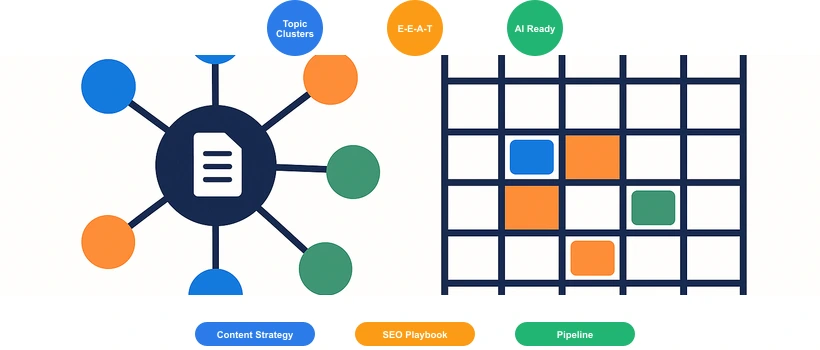
Topic cluster architecture is the most reliable structural approach for building topical authority in B2B SEO. The core model is straightforward: one pillar page comprehensively covers a broad topic, and a set of cluster pages address specific sub-questions that the pillar introduces but does not answer in depth. All cluster pages link back to the pillar; the pillar links forward to each cluster page.
Why Topical Depth Outranks Individual Strong Articles
This structure works because Google’s systems evaluate topical coverage, not just individual page quality. A site that publishes one strong article on “B2B SEO” ranks below a site that has covered B2B SEO across 15 to 25 interconnected pages, because the second site demonstrates depth across the entire topic. Implementing a robust topic cluster strategy for B2B brands consistently accelerates ranking velocity for head terms compared to publishing isolated posts.
The relationship between topic clusters and semantic SEO strategy is direct: clusters create the entity and topic relationships that semantic search algorithms use to assess topical authority. A well-built cluster is not just an internal linking tactic; it is a signal about your site’s expertise boundary.
Four Steps to Build a B2B Topic Cluster
- Define the pillar topic at the right altitude: specific enough to be actionable (not “marketing”), broad enough to support 10-20 cluster posts (not “B2B email subject line length”). Good pillar topics: “B2B content SEO,” “B2B demand generation,” “B2B marketing automation.”
- Map spoke topics by listing every specific question, sub-topic, and use-case that a pillar reader might want to go deeper on. Each spoke should target a unique keyword phrase that the pillar does not rank for.
- Build the internal link architecture before publishing: document which cluster pages link to which other cluster pages (lateral links), which ones link up to the pillar, and which service or product page gets one natural link from each cluster post. This pre-planning prevents orphan posts and link clustering mistakes.
- Publish the pillar first, then publish spokes with internal links back to the pillar. Update the pillar as each new spoke goes live to add the forward link. Track pillar ranking position as a leading indicator of cluster health.
Cluster Maintenance Using GSC Data
After building a cluster, set a quarterly review cadence using GSC > Performance > Pages. Sort by impressions descending. Any cluster page with high impressions but low click-through rate (under 2%) has a title and meta description problem. Any cluster page with no impressions after 90 days either targets a keyword with zero search demand or has a technical indexing issue.
E-E-A-T: How B2B Content Earns Topical Authority
E-E-A-T (Experience, Expertise, Authoritativeness, Trustworthiness) is not a direct ranking factor but a quality framework that Google’s Search Quality Rater Guidelines use to evaluate content quality. According to Google’s Search Central helpful content documentation, content that demonstrates first-hand experience and genuine expertise consistently outperforms content that aggregates information available elsewhere. For B2B brands, this translates into concrete content choices.
The full framework for how B2B content demonstrates strong E-E-A-T for B2B brands covers signal implementation in depth. Here are the most actionable content-level signals:
Demonstrating Experience in B2B Content
- Include specific, named client scenarios or internal implementation examples (even without disclosing the client name, describing the setup in precise terms signals real experience)
- Reference actual tool outputs: screenshots from Screaming Frog, GSC reports, Ahrefs data exports. Descriptions of real tool interfaces signal hands-on use.
- Use first-person plural (“we found that,” “in our audits”) where the team has direct experience, rather than always writing in the third person about theoretical approaches
Expertise and Authoritativeness Signals
- Named authorship on every post: author bio with verifiable credentials, LinkedIn profile link, and any relevant certifications or publications
- Cite named studies and specific data sources (not “studies show”). Examples: “the Semrush State of Search 2025 report found,” “Google’s December 2025 core update expanded E-E-A-T evaluation”
- Use precise, accurate technical terminology. Vague language (“make your website faster”) signals low expertise compared to precise language (“reduce Largest Contentful Paint below 2.5 seconds by preloading your hero image”)
According to Ahrefs’ E-E-A-T and SEO analysis, the sites that gain the most from Google’s helpful content updates are those with strong author entities tied to content, not just anonymous corporate blog posts. For B2B brands, investing in building author profiles with genuine subject-matter depth is one of the highest-leverage E-E-A-T improvements available.
Trustworthiness Through Citations and Accuracy
- External citations from named, high-authority sources (Google Search Central, Ahrefs, Semrush, Moz, Search Engine Journal) placed at the exact claim location, not in a bibliography section
- Accurate descriptions of tools, platforms, and products with current version context. Outdated screenshots or references to deprecated features signal content that has not been maintained
- Clear disclosure of methodology for any original data or research presented
Content Formats That Drive B2B Organic Traffic and Pipeline
B2B content SEO performs best when the content format matches the specific search intent. Generic blog posts work for brand awareness. The formats below are what drive measurable pipeline.
Comparison Pages and How-To Implementation Guides
Comparison pages (vs pages) target BOFU buyers who are finalizing a vendor decision. “Your Product vs Competitor A” pages rank for the exact queries that decision-stage buyers type. They convert at 3 to 5 times the rate of generic blog posts because the visitor is already in final evaluation. Key requirements: honest presentation of both options’ strengths, specific feature comparison tables, customer scenario examples, and a clear answer to “which is better for X type of company.”
How-to guides targeting technical implementation queries capture B2B buyers who search for implementation guidance before purchase. “How to set up [Product] with [Integration],” “how to run [process] for [industry],” and “step-by-step [methodology] guide” queries capture technical evaluators who carry significant purchase influence. These guides should include real screenshots, exact command syntax where relevant, numbered steps with bold labels, and troubleshooting sections. They also generate high-quality backlinks from practitioners who reference them in forums and community threads.
Deciding on the right scope and depth for these guides requires matching format to search demand. The analysis in optimal content length for B2B SEO covers how to calibrate depth by topic competitiveness and funnel stage.
Case Studies and Original Research Reports
Case studies with specific, measurable outcomes perform two jobs simultaneously: they rank for “[industry] + [outcome] + [your category]” queries and they convert readers who have already decided on the category and are evaluating vendors. The SEO performance of case studies depends entirely on specificity. “We helped a SaaS company grow organic traffic by 47% in 8 months using topic cluster architecture and quarterly technical audits” generates impressions for dozens of specific query variants. “We helped a client see great results” generates none.
Original research and data-driven content consistently generates more referring domains per published piece than any other content format, according to Moz’s analysis of link acquisition strategies. For B2B brands, this means publishing proprietary survey data, benchmark reports, or analysis of anonymized platform data. Original research builds authority on two levels: it generates backlinks from other content creators who cite it, and it satisfies E-E-A-T requirements by demonstrating first-party expertise and evidence.
Content Formats That Underperform in B2B SEO
- Generic thought leadership without evidence. “Why content marketing matters in 2026” with no data or original perspective earns no rankings and no trust signals.
- Top-10 listicles that recycle SERP competitors. If every item in your list also appears in the top 3 ranking posts, you have added no information value. AI Overviews are already synthesizing this information.
- Gated content hidden behind forms. Gated whitepapers that are not indexable contribute nothing to content SEO. Build a free-access summary page that is fully indexable, and gate only the extended data or implementation templates within it.
Optimizing B2B Content for AI Overviews and Generative Search
AI Overviews, ChatGPT with web search, Perplexity, and similar tools now intercept a meaningful portion of B2B research queries before the buyer ever clicks through to a website. The strategic implication is that B2B content SEO must now optimize for citation within AI-generated answers, not just traditional organic rankings.
The principles of AI Overview optimization and broader generative engine optimization share the same core premise: AI models extract answers from content that is structured for extraction, not content that assumes readers will read linearly.
Formatting Content for AI Extraction
- Answer-first formatting. Lead every section with a direct answer to the implied question, then expand with context and evidence. AI models extract the answer from the first 2 to 3 sentences of each section. If your section starts with context and arrives at the answer in paragraph 4, it is less likely to be cited.
- FAQ sections with concise answers. Structured FAQ content with schema markup is directly consumed by AI Overview generation. Each FAQ answer should be 2 to 4 sentences that stand alone as a complete response to the question, without referencing surrounding context.
- Specific, nameable facts. AI models prefer to cite specific data points, named tools, and concrete process steps. “Reduce LCP below 2.5 seconds” is more citable than “improve your page speed.” Specificity is the primary citation selection signal.
- Clean HTML structure. AI crawlers parse HTML to extract content. Use semantic HTML tags (h2, h3, ul, ol, table) correctly. Avoid content locked in JavaScript-rendered components, modals, or tabs that require interaction to display.
According to Semrush’s AI Overviews research, the pages most commonly cited in AI Overviews are those with explicit FAQ structure, strong E-E-A-T signals, and schema markup present. For B2B content, this means every pillar post and how-to guide should include a structured FAQ section with FAQPage schema, and every claim should be backed by a citable source.
Schema Markup for AI Readiness
Beyond FAQPage schema, B2B content pages benefit from Article schema with a defined author entity, HowTo schema for step-by-step guides, and BreadcrumbList schema for all pages. These structured data types provide clear content context to both traditional search crawlers and AI retrieval systems. Validate all schema at validator.schema.org after any content update to confirm the structured data is parsing correctly.
Measuring B2B Content SEO Performance
B2B content SEO measurement has two failure modes: measuring too little (only keyword rankings) and measuring too much (every vanity metric in the dashboard). The right framework connects content performance to pipeline, using a small set of metrics at each layer of the funnel.
Search Visibility and Traffic Quality Metrics
Layer 1: Search visibility metrics (weekly)
- Target keyword rankings for your top 20 commercial keywords, tracked weekly in Ahrefs or Semrush
- Organic impressions and click-through rate per page in GSC > Performance > Pages, compared week-over-week and to the same period 90 days prior
- Pages with declining impressions (potential algorithm impact or cannibalization issues) flagged for content review
Layer 2: Traffic quality metrics (monthly)
- Organic sessions per landing page in GA4, segmented by source/medium to isolate organic search
- Engagement rate (GA4’s replacement for bounce rate) for organic landing pages. B2B content pages should target above 55% engagement rate. Below 40% indicates a keyword-content mismatch.
- Scroll depth and time on page for pillar and hub posts. Content with high impressions but low scroll depth (under 50%) needs structural improvement, not more promotion.
Pipeline Attribution from Organic Content
- Organic-attributed form submissions and demo requests, tracked via GA4 goal completions with utm_source=organic filter
- First-touch attribution from organic: which content pieces initiate the most buyer journeys that later convert to opportunities
- Content-assisted opportunities: CRM data showing which content pieces appear in the multi-touch path of closed or advancing deals
| Metric Category | Metric | Tool | Review Cadence |
|---|---|---|---|
| Visibility | Keyword rankings for target terms | Ahrefs / Semrush | Weekly |
| Visibility | Organic impressions and CTR per page | Google Search Console | Weekly |
| Traffic Quality | Organic sessions per landing page | GA4 | Monthly |
| Traffic Quality | Engagement rate for organic pages | GA4 | Monthly |
| Pipeline | Organic-attributed form fills and demo requests | GA4 + CRM | Monthly |
| Pipeline | First-touch organic opportunity attribution | CRM (HubSpot / Salesforce) | Monthly |
| Content Health | Cluster coverage gaps and decay alerts | GSC + Ahrefs | Quarterly |
Identifying and Remediating Content Decay
B2B content SEO is not a publish-and-forget system. According to Ahrefs’ content decay research, most organic content peaks in rankings within 6 to 12 months of publication and then gradually loses positions as newer, more comprehensive content is published by competitors. Quarterly content audits using GSC > Performance > Pages, sorted by year-over-year impression decline, identify decaying content before it loses significant ranking position. The remediation is typically a content refresh: adding new sections for emerging sub-topics, updating statistics and screenshots, and improving E-E-A-T signals.
The full measurement framework for B2B content SEO services that connects content performance to revenue attribution is a combination of these three layers applied consistently over a 12-month horizon. Teams that review all three layers monthly and act on findings within the same month consistently compound their organic channel velocity.
Frequently Asked Questions
What is B2B content SEO?
B2B content SEO is the practice of creating and optimizing content to attract organic traffic from business buyers across all stages of the purchase cycle. It targets multiple decision-makers at target accounts, focuses on high-intent but lower-volume keywords, and measures success through qualified pipeline rather than raw traffic volume.
How is B2B content SEO different from B2C?
B2B purchases involve 6 to 10 stakeholders and 6 to 12-month evaluation timelines, requiring content that addresses multiple buyer personas at different depths. B2B content SEO targets specific, lower-volume keyword phrases with high commercial intent and measures performance through lead and pipeline attribution rather than e-commerce transactions.
How long does B2B content SEO take to show results?
Initial ranking improvements for long-tail keywords typically appear within 3 to 6 months. Competitive head terms take 6 to 12 months, and the compounding pipeline effect from a well-structured topic cluster usually emerges between 9 and 18 months of consistent publishing.
What content formats work best for B2B SEO in 2026?
The highest-performing formats are comparison pages targeting vendor-aware buyers, how-to guides for technical implementation queries, case studies with measurable outcomes, and original research reports. These outperform generic thought leadership because they match specific buyer intent at decision and evaluation stages.
How do you measure B2B content SEO ROI?
Connect organic sessions to pipeline using GA4 goal completions for form fills and demo requests attributed to organic, then map those goals to CRM opportunity creation. Key metrics are organic-sourced pipeline value, content-attributed lead volume by funnel stage, and 90-day rolling keyword ranking changes in Google Search Console.
How many words should a B2B SEO blog post be?
For competitive B2B topics, 3,500 to 5,000 words is the target range for pillar and hub posts. Supporting cluster posts addressing narrow queries can be 1,500 to 2,500 words. Word count should follow content completeness requirements, not an arbitrary target.
Our B2B content SEO team builds topic cluster architecture, produces E-E-A-T content at scale, optimizes for AI Overviews, and connects every piece to pipeline. We work with B2B marketing directors across US, UK, Europe, and Dubai.