



How to Optimize for AI Overviews in 2026
Table of content
Google AI Overviews have fundamentally changed how B2B buyers encounter information in search results. Instead of clicking through to your page, buyers now read a synthesized answer at the top of the results page, with source citations listed below. Whether your content is cited or ignored in that summary is no longer a passive outcome of your organic rankings. It is an active decision point that demands specific optimization.
This guide covers exactly how to optimize for AI Overviews in 2026: the factors that determine inclusion, the content structures and schema implementations that maximize citation rates, and the E-E-A-T signals that distinguish pages Google trusts to synthesize from. If you are building a broader content program designed to capture AI-driven search surfaces, the B2B content SEO fundamentals that govern traditional organic performance are the same foundation AI Overviews selection is built on.
What Google AI Overviews Are and Why They Matter for B2B SEO
AI Overviews are generative AI summaries that appear at the top of Google search results for eligible queries. Launched in the US in May 2024 and expanded globally through late 2024, they now appear for a significant share of informational and long-tail queries across all verticals, including B2B.
How AI Overviews Differ from Featured Snippets
The distinction is important for optimization strategy. Featured snippets pull a verbatim excerpt or list from a single page. AI Overviews synthesize information from multiple sources, generate a new answer in Google’s own words, and then cite the pages that contributed to that answer, typically 3 to 8 source pages per Overview.
This means AI Overview optimization is not about crafting a single perfect answer box. It is about ensuring your content is among the trusted sources Google draws on when synthesizing an answer across multiple pages. Multiple pages from your domain can be cited in a single AI Overview if your topic cluster covers the subject comprehensively.
The Scale and Reach of AI Overviews in 2026
The growth of AI Overviews across the search results page has been significant. Semrush’s AI Overviews study analyzing over 10 million keywords documented that AI Overviews now appear for a substantial portion of question-based queries and that this share increased significantly through 2025 as Google expanded the feature to more query types and geographies.
For B2B search behavior, this matters for a specific reason: B2B buyers increasingly research with long-form, conversational queries rather than short keyword strings. Queries that are 8 or more words are substantially more likely to trigger an AI Overview than shorter queries. B2B buying research inherently tends toward these longer, more specific queries, making AI Overview visibility disproportionately important for B2B content programs.
What Happens to Organic Traffic When AI Overviews Appear
Pages that are not cited in an AI Overview see reduced click-through rates on queries where the AI Overview appears, because users can get the answer directly on the results page without clicking through. Pages that are cited as sources see a partial offset: being listed as a citation carries both a visibility benefit and a signal of authority that tends to attract clicks from buyers who want to verify the source or read more deeply.
The net strategic implication: ignoring AI Overviews is not a neutral choice. For any B2B content program, the queries where your pages rank but are not cited in the AI Overview are now generating less traffic than they did before AI Overviews existed. Optimizing for citation is the only way to maintain organic traffic performance on those queries.
The Key Factors That Determine AI Overview Inclusion
Google does not operate a separate algorithm for AI Overview selection. According to Google Search Central’s documentation on AI features, AI Overviews use the same core ranking systems as standard Google Search. This means the factors that drive AI Overview citation are amplified versions of the factors that already drive organic rankings, not a separate set of requirements.
Organic Ranking Position as the Entry Requirement
The most important prerequisite is organic ranking. Research consistently shows that more than 99% of AI Overview citations come from pages ranking in the top 10 organic results for that query. Pages outside the top 10 are rarely cited. This means AI Overview optimization is not a shortcut to visibility for pages that rank poorly organically. It is an amplification layer for pages that already rank.
Importantly, AI Overviews do not always cite the top-ranking page. A meaningful proportion of citations come from pages ranking at positions 3 through 10, not exclusively from position 1. This indicates that content quality, structure, and schema signals influence which pages within the top 10 are selected for synthesis, creating a real optimization opportunity for pages that rank but are not currently being cited.
Semantic Completeness and Topical Authority
AI Overview selection favors pages that provide comprehensive coverage of a topic rather than narrow answers to single questions. A page that answers a question and also covers the related questions a buyer is likely to have next signals semantic completeness to Google’s evaluation systems.
This is where topic cluster architecture has a direct impact on AI Overview performance. A well-structured topic cluster, where a pillar page covers the broad subject and cluster pages each cover specific subtopics in depth, gives Google a comprehensive topical landscape to draw from. When synthesizing an AI Overview for a broad informational query, Google is more likely to cite multiple pages from a domain with comprehensive cluster coverage than a single page from a domain with isolated content.
Content Structure and Answer-First Formatting
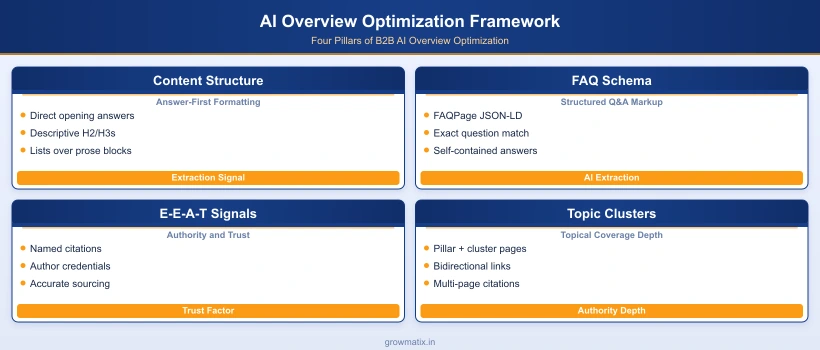
AI systems extract information most efficiently when content is organized with clear hierarchical headings and direct answers at the top of each section. The structure that correlates most strongly with AI Overview citation has three characteristics:
- Answer-first paragraphs: Each H2 and H3 section should open with a direct 1 to 3 sentence answer to the question implied by the heading, before expanding into supporting detail.
- Explicit heading questions: H2 and H3 headings phrased as questions or as clear topic statements signal to AI extraction systems what the following content answers.
- Scannable formatting: Bullet points, numbered steps, and comparison tables break content into discrete, extractable units. Dense paragraph blocks are harder for AI systems to synthesize efficiently.
Research on LLM citation patterns indicates that a disproportionate share of citations are drawn from the first portion of an article, meaning the introduction and first H2 section carry outsized weight. Write the introduction to your articles as a concise summary of the key answers, not as a build-up to those answers.
E-E-A-T Signals That Influence AI Citation
Google’s AI systems synthesize from pages they trust. Trust, in Google’s evaluation framework, is built through Experience, Expertise, Authoritativeness, and Trustworthiness (E-E-A-T) signals. For B2B content, the most actionable E-E-A-T signals that correlate with AI Overview citation are:
| E-E-A-T Signal | What It Looks Like in Content | AI Overview Impact |
|---|---|---|
| Experience | Real-world examples, before/after scenarios, implementation specifics that generic coverage lacks | Differentiates your content from thin coverage of the same topic |
| Expertise | Named authors with credentials, precise industry terminology used correctly, depth that reflects genuine subject-matter knowledge | Signals trustworthiness for synthesis; AI systems favor authoritative sources |
| Authoritativeness | Citations from named, credible sources (Google Search Central, Ahrefs, Semrush, industry research); backlinks from relevant domains | External validation signals increase citation probability |
| Trustworthiness | Accurate claims with verifiable sources; no unattributed statistics; clear publication and update dates | AI systems avoid citing pages with credibility red flags |
FAQ Content and Direct Answer Sections
FAQ sections are among the highest-performing content formats for AI Overview extraction. When a FAQ item is structured with the question as a heading and the answer in the immediately following paragraph, it provides exactly the format AI systems are designed to extract and synthesize: a clear question paired with a direct, concise answer.
For B2B content, FAQ sections should target the specific questions B2B buyers type into search, not generic definitions. Use People Also Ask results and Google’s autocomplete suggestions for your primary keyword to identify the exact question phrasing that buyers use. These are the questions your FAQ items should address, using the buyer’s language rather than your internal vocabulary.
How to Optimize Content for Google AI Overviews: Step by Step
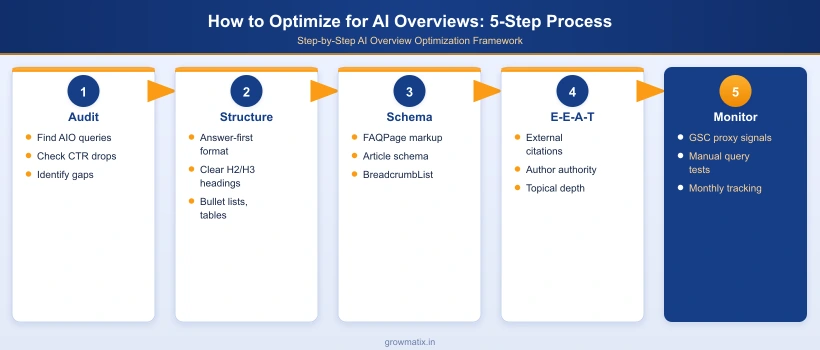
The optimization process for AI Overviews has five sequential steps. Steps 1 and 2 address content foundations. Steps 3 and 4 address technical and authority signals. Step 5 addresses ongoing monitoring, which is required because AI Overview appearance is not static.
Step 1: Identify AI Overview-Eligible Queries in Your Target Keyword Set
Start by auditing which queries in your existing organic keyword set are already triggering AI Overviews. Use Semrush Position Tracking > SERP Features or Ahrefs Keywords Explorer > SERP Overview to check which tracked keywords display an AI Overview. Prioritize those queries for optimization.
Query characteristics that predict AI Overview eligibility:
- Informational intent: “how to,” “what is,” “why,” “when should,” “guide to”
- Long-tail phrasing: 5 or more words in the query string
- Question format: the query is a complete question rather than a keyword string
- Comparative intent: “vs,” “difference between,” “which is better”
- Process queries: “steps to,” “how do I,” “how does X work”
For B2B brands, your most valuable AI Overview targets are likely mid-funnel informational queries that buyers research during the evaluation phase of a purchase cycle. These queries combine high relevance to your solution with the informational intent that AI Overviews favor.
Step 2: Reformat Existing Content with Answer-First Structure
For each page targeting an AI Overview-eligible query, audit the content structure against the answer-first standard. Specifically:
- Check the first paragraph of each H2 section: Does it open with a direct 1 to 2 sentence answer to the question implied by the heading? If not, rewrite it to lead with the answer before expanding.
- Evaluate heading phrasing: Are H2 and H3 headings specific and descriptive rather than clever or vague? “How AI Overviews Select Content to Cite” outperforms “Understanding the Algorithm” as a heading from an AI extraction standpoint.
- Convert dense paragraphs to structured lists where appropriate: If a paragraph lists three or more parallel items, convert it to a bullet list. Bullet lists are extracted by AI systems more reliably than prose lists embedded in paragraphs.
- Add comparison tables to sections covering multiple options: Tables are one of the highest-performing content formats for AI Overview extraction, particularly for comparison and evaluation queries.
- Move the most important answer to the first sentence of the article: The introduction should summarize the key answer before building context. AI systems extract from the beginning of articles at higher rates than from middle or end sections.
Step 3: Build FAQ Sections Optimized for AI Extraction
Every page targeting an informational query should include a FAQ section structured specifically for AI Overview extraction. The correct structure is:
- Each FAQ item uses the exact question phrasing from People Also Ask, Google autocomplete, or keyword research tools
- The answer is 2 to 4 sentences: concise enough to be extractable, comprehensive enough to be the definitive answer
- The answer stands alone, meaning a reader can understand it without reading the surrounding article
- The FAQ section is implemented with FAQPage schema markup so Google can identify the Q&A structure programmatically
For the FAQ section to improve AI Overview citation rates, it needs to address the actual questions buyers search, not the questions your marketing team thinks buyers ask. Pull FAQ questions directly from Google Search Console > Queries filtered to question-format keywords, from the People Also Ask boxes that appear for your target keyword, and from the autocomplete suggestions Google shows when you type your primary keyword.
Step 4: Build Domain-Level E-E-A-T Signals
AI Overview citation is influenced by domain-level trust signals, not just page-level optimization. A page on a domain with strong E-E-A-T signals across its content program is more likely to be cited than an equivalent page on a thin domain, even if both pages rank similarly for the same query.
Domain-level E-E-A-T improvements that correlate with AI Overview citation:
- Author authority: Add named author profiles with credentials, publications, and expertise signals to your content. Google’s evaluation systems use author entity signals as part of E-E-A-T assessment.
- External citation density: Each blog post should cite 3 to 4 specific, named external sources (Google Search Central, Ahrefs, Semrush, industry research). Vague attributions (“studies show,” “experts say”) do not contribute to trustworthiness signals.
- Content consistency and depth: A domain that consistently publishes comprehensive, accurate content on a topic builds topical authority faster than one that publishes sporadically or at shallow depth.
- Branded search volume: Research on AI citation patterns shows that branded web mentions have a stronger correlation with AI Overview appearances than link metrics. Content programs that build genuine brand recognition in a niche outperform purely link-focused programs for AI visibility.
Step 5: Build Topic Cluster Depth to Support AI Overview Coverage
The strongest structural signal for sustained AI Overview citation is comprehensive topic cluster architecture. When Google needs to synthesize an answer to a broad informational query, it draws from the most authoritative source on the topic. A domain with a pillar page and 8 to 12 interconnected cluster pages covering every angle of a subject is more authoritative than a domain with a single well-optimized page on the same subject.
Topic cluster architecture supports AI Overview optimization in three ways:
- Breadth of coverage: Each cluster page covers a distinct subtopic, collectively covering the full semantic neighborhood of the pillar topic. When Google synthesizes an AI Overview for any query in that neighborhood, your domain has a relevant page to cite.
- Internal link authority flow: Bidirectional internal linking between pillar and cluster pages passes topical authority signals across the cluster, amplifying the ranking and citation probability of every page in the cluster.
- Multiple citation opportunities: A single AI Overview for a broad query may cite 5 to 8 sources. A well-built topic cluster can occupy multiple citation slots, not just one, for queries where your pillar topic is the subject.
Understanding how to implement generative engine optimization for AI search beyond Google, including ChatGPT, Perplexity, and Gemini, requires this same topical depth foundation. The citation patterns across AI platforms share a common underlying factor: comprehensive, authoritative content within a well-structured domain architecture.
Schema Markup Strategy for AI Overview Visibility
Structured data does not directly control AI Overview selection, but it helps Google parse your content structure with less ambiguity. Pages with clean, accurate schema markup give AI systems more reliable extraction targets than pages where content structure must be inferred from HTML alone.
FAQPage Schema: Direct Q&A Extraction for AI Overviews
FAQPage schema is the single most impactful structured data type for AI Overview optimization. It explicitly maps each FAQ item as a Question with an acceptedAnswer, giving Google’s extraction systems a programmatic map of every Q&A pair on your page.
Implementation rules for effective FAQPage schema:
- Each Question must exactly match the visible question text on the page; schema that differs from visible content creates conflicting signals
- Answers should be complete and self-contained: the text in the schema answer field should make sense without surrounding context
- Limit FAQPage schema to pages where the primary content format is genuinely Q&A; applying it to every page regardless of content type dilutes its signal value
- Include all FAQ items on the page in the schema, not a subset; partial schema coverage is a red flag for quality evaluation systems
The complete implementation pattern, including how FAQPage schema integrates with Article and BreadcrumbList schema in a single @graph block, is covered in the guide to schema markup for AI visibility on B2B pages. The @graph approach ensures all schema types are validated as separate entities while maintaining the relational links between them.
Article Schema and Content Authority Signals
Article schema signals content type, publication date, modification date, and author entity to Google’s evaluation systems. For AI Overview selection, the modification date field is particularly important: AI Overviews favor fresh content for queries where accuracy depends on recency. Pages that are regularly updated and reflect the current modification date in their Article schema are prioritized for queries with implicit freshness requirements.
Required fields in Article schema for AI Overview optimization:
- headline: Must match the H1 of the page exactly
- datePublished and dateModified: Use ISO 8601 format; keep dateModified current when content is updated
- author: Link to a Person or Organization entity with @id reference; entity-linked authors signal stronger E-E-A-T than anonymous authorship
- publisher: Link to the Organization entity using @id reference, not a standalone publisher object
BreadcrumbList Schema and Site Architecture Signals
BreadcrumbList schema communicates your site’s content hierarchy to Google’s systems. For AI Overview optimization, it signals that the page exists within a structured content architecture rather than as an isolated post. Combined with strong internal linking and topic cluster architecture, BreadcrumbList schema helps Google understand the relational context of each page within your overall content program.
All three schema types (Article, FAQPage, BreadcrumbList) should be implemented in a single application/ld+json script block using the @graph array format. This ensures Google parses all schema entities together and can resolve the @id references that link Article to Organization, avoiding the fragmented schema quality issues that arise when multiple separate script blocks are used on the same page.
How to Monitor Your AI Overview Performance
AI Overview appearances are dynamic: a page that is cited today may not be cited next week, and a page that is not currently cited may be selected after a content update. Monitoring requires both manual testing and systematic tracking.
Google Search Console Proxy Signals for AI Overview Tracking
Google Search Console does not yet provide a dedicated AI Overview report. Use these proxy signals to track AI Overview impact on your content:
- Impression-to-click divergence: Filter your top 50 informational queries. Queries with high impressions but unusually low CTR (below 3% for a top-5 ranking) may have an AI Overview capturing clicks that previously went to your organic result. This pattern indicates where AI Overview citation optimization would have the most traffic recovery impact.
- CTR trend over time: For pages that previously held featured snippets, compare CTR before and after AI Overviews rolled out for those queries. Pages where CTR dropped sharply on informational queries but impressions held steady are likely being outcompeted by AI Overviews.
- Query expansion tracking: As your content cluster grows, monitor whether new keyword variations are generating impressions on your pillar and cluster pages. Impression expansion for a broader range of queries is the earliest signal of topical authority growth that precedes AI Overview citation inclusion.
Manual Testing Protocol for AI Overview Citation
Build a manual testing protocol for your top 30 to 50 target queries. Manual testing is currently more reliable than automated tracking because AI Overview appearances vary by user location, signed-in status, and query phrasing variation.
- Test in a private browsing window to avoid personalization affecting results; sign out of all Google accounts before testing
- Use exact-match query phrasing matching the specific keywords in your target list, not paraphrased versions
- Record whether an AI Overview appears and if so, whether your domain is cited and which URL is cited
- Test variations of each query (question format, keyword format, conversational format) to understand which phrasing triggers citation
- Run tests monthly at minimum; major Google algorithm updates frequently affect AI Overview citation patterns and require prompt response
For ongoing AI Overview performance management at scale, the SEO services team at Growmatix implements AI Overview citation tracking as a standard component of B2B content program management, connecting citation data to organic traffic and pipeline attribution reporting on a monthly basis.