



Topic Cluster Strategy for B2B Brands: Build Authority, Not Just Traffic
Table of content
Most B2B content programs publish posts that compete independently. Each piece targets a keyword, earns its ranking, and sits there in isolation. The problem with this approach is not that it fails entirely. It’s that it leaves most of the authority signal on the table. Search engines do not just evaluate individual pages; they evaluate whether a site demonstrates comprehensive knowledge of a subject. Topic cluster strategy is how you build that signal systematically.
This guide covers the complete topic cluster strategy for B2B brands: what a cluster is, why B2B buying cycles make it more important here than in any other content context, and exactly how to research, build, and expand a cluster that drives both organic rankings and qualified pipeline. If you’re already investing in content production and want to understand how it fits into a broader content framework, the B2B content SEO playbook covers the full strategic layer this cluster architecture sits within.
What Is a Topic Cluster Strategy in B2B SEO
A topic cluster is a group of interlinked content pages that collectively cover one broad subject area. The structure has three components: a pillar page, a set of cluster pages, and the internal links connecting them. Each component plays a specific role in how search engines evaluate and rank the content.
The Three Layers: Pillar, Clusters, and Internal Links
The pillar page covers a broad topic comprehensively, typically 3,000 to 5,000 words, touching on every major subtopic without going into exhaustive detail on any one of them. It links outward to each cluster page for deeper coverage. Think of it as the topic’s authoritative overview, the page a buyer would read to get a complete picture of the subject before deciding which area to explore in depth.
Cluster pages each address one specific subtopic of the pillar topic in depth, typically 1,500 to 2,500 words. A cluster page on “topic cluster strategy B2B” might have cluster pages on pillar page SEO best practices, internal linking for content clusters, how to measure topical authority, and content cluster keyword research. Each cluster page links back to the pillar and may link to related cluster pages where relevant.
Internal links are what make the cluster work as an SEO signal rather than just a content organization system. The bidirectional linking between pillar and cluster pages passes PageRank, consolidates crawl paths, and tells search engines that these pages belong to the same topical neighborhood. Search Engine Land’s definitive guide to topic clusters describes this linking architecture as the mechanism that transforms individual pages into a coherent authority signal for the entire topic.
How Topic Clusters Signal Topical Authority to Google
Google’s algorithms evaluate a domain’s expertise on a subject by looking at breadth and depth of coverage, not just individual page quality. A site with 12 interlinked pages covering every major angle of “B2B content strategy” signals comprehensive expertise. A site with one highly optimized page on the same keyword signals isolated relevance. Google’s quality evaluator guidelines specifically reference the concept of expertise across a topic domain as a component of how E-E-A-T is assessed at the site level, not just at the page level.
The practical effect: pillar pages in well-built topic clusters rank faster and hold rankings longer than standalone pages targeting the same keyword, because the cluster provides the topical context that the pillar page alone cannot.
Why B2B Brands Specifically Need a Topic Cluster Approach
Topic cluster strategy benefits any content program. But it is structurally more important for B2B brands than for B2C for three specific reasons tied to how B2B buyers research and how B2B purchase decisions are made.
Multiple Buyer Personas Require Multi-Level Content Coverage
A typical B2B software purchase involves 6 to 10 stakeholders with different roles, technical backgrounds, and research priorities. The end user researches implementation and workflow impact. The technical evaluator researches integration architecture and security. The finance approver searches for ROI data and pricing benchmarks. The executive sponsor looks for strategic case studies and analyst recognition.
Each of these personas searches with different keywords and needs different content formats. A topic cluster built around a B2B category can systematically cover all of these search intents within a single connected architecture: the pillar page serving broad strategic buyers, cluster pages serving technical evaluators, comparison pages serving mid-funnel researchers, and FAQ content serving buyers close to decision. No standalone page can do this. A cluster can.
Long Sales Cycles Mean Buyers Research Across Dozens of Queries
B2B purchase cycles commonly span 6 to 12 months. During that period, a single buyer visits your content multiple times and researches multiple angles of the same problem. A buyer who first lands on your pillar page about B2B content strategy will return weeks later searching for something more specific: a comparison table, an implementation guide, a specific tool evaluation. If your cluster covers those queries, every return visit comes back to your domain. If it doesn’t, those queries send the buyer to a competitor’s content.
This compounding effect is why building topical depth matters more than maximizing individual page rankings. The buyer journey is not linear, and the content architecture that wins is the one that meets buyers at every stage of their research without requiring them to leave your site.
Google’s Helpful Content System Rewards Comprehensive Topical Coverage
Google’s Helpful Content system, updated through multiple core updates since 2022, evaluates whether a page adds value beyond what’s already available on the topic. A page that covers a subtopic comprehensively because it exists within a well-built cluster, rather than as an isolated post, consistently performs better in post-update recovery analyses. Google Search Central’s guidance on creating helpful content explicitly calls out demonstrating expertise across a topic as a positive signal, which aligns directly with the comprehensive coverage a properly built topic cluster provides.
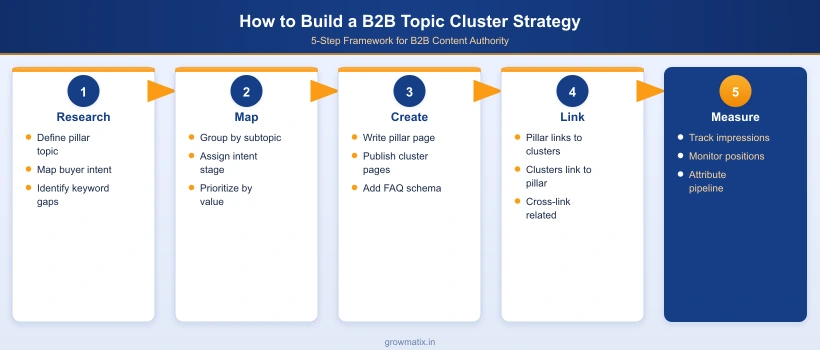
How to Build a B2B Topic Cluster Strategy Step by Step
The process has five sequential steps. Skipping or rushing any step typically produces a cluster that looks organized on a spreadsheet but fails to drive rankings because the keyword foundation or the internal linking is incomplete.
Step 1: Define Your Pillar Topic Around a Revenue-Critical Theme
Start with business outcomes, not keyword volume. The pillar topic should align with a category your sales team actively sells into. If your product solves a specific B2B problem, that problem category is your pillar topic. The pillar keyword is the broad head term that B2B buyers in your market use to start researching that category.
Filter pillar topic candidates by three criteria:
- Commercial relevance: Does ranking for this topic generate pipeline, not just traffic?
- Keyword depth: Are there at least 10 to 15 specific long-tail keywords branching off from this topic?
- Competitive gap: Is there a real coverage gap in existing content on this topic that your expertise can fill?
Most B2B companies have 3 to 5 viable pillar topics. Pick one, build it to completion, then move to the next. Partially built clusters do not drive topical authority.
Step 2: Map Cluster Pages Using Keyword Research
Use keyword research tools to extract every question, comparison, and process query related to your pillar topic. In Ahrefs, this means running the pillar keyword through the Questions, Terms Match, and Related Terms filters to build a full cluster map. In Semrush, the Topic Research and Keyword Magic tools produce similar maps.
Group the resulting keywords into subtopics. Each distinct subtopic with at least 3 to 5 related keyword variations becomes a cluster page candidate. The goal is to identify natural semantic groupings, not to manufacture one page per keyword.
Ahrefs’ research on topical authority and content clusters found that pages within well-structured clusters consistently rank for more keyword variations than equivalent standalone pages, because the cluster context reinforces the semantic relevance of each page’s target topic.
Step 3: Write the Pillar Page as a Comprehensive Topic Overview
The pillar page must earn its position as the authoritative overview. This means covering every major subtopic at a summary level, not going deep on any one of them (that depth belongs in cluster pages), and linking explicitly to each cluster page where the topic is covered in full.
Pillar page content requirements:
- One H1 targeting the broad pillar keyword
- H2 sections covering each major subtopic, with H3s under each
- One to two paragraphs per subtopic, with a clear signal to the cluster page for more depth
- FAQ section structured for AI Overview extraction
- Schema markup: Article + FAQPage + BreadcrumbList
- 3 to 4 external citations from authoritative sources placed where claims are made
Step 4: Publish Cluster Pages That Deep-Dive Each Subtopic
Each cluster page should make the subtopic its primary focus, not a secondary discussion. The keyword in the pillar overview becomes the primary keyword of the cluster page. Content depth here is where the cluster demonstrates to search engines that your site covers the topic with genuine expertise, not just surface-level summaries.
The approach to building topical authority for B2B starts with this layer: publishing cluster pages that are genuinely more comprehensive and useful than what competitors have published on the same subtopics. Generic cluster pages that cover the same ground as the pillar page without adding depth defeat the purpose of the cluster architecture entirely.
Step 5: Build Bidirectional Internal Links Between Pillar and Clusters
Internal linking is not optional or decorative in a topic cluster. It is the mechanism that creates the topical signal. Every cluster page must contain a contextual link back to the pillar page, and the pillar page must contain a contextual link to every cluster page. These links should appear naturally within the body content where the topic is discussed, not as a sidebar navigation element or a callout box labeled “Related Posts.”
Use keyword-rich anchor text that describes the destination page’s primary topic. Avoid generic anchors like “read more” or “learn more here.” The anchor text itself communicates to search engines what the linked page is about, reinforcing the cluster’s semantic coherence.
Content Architecture: What Each Layer of a B2B Topic Cluster Should Cover
Understanding the structural role of each content layer prevents the most common cluster-building mistake: publishing pages at the wrong depth for their position in the cluster.
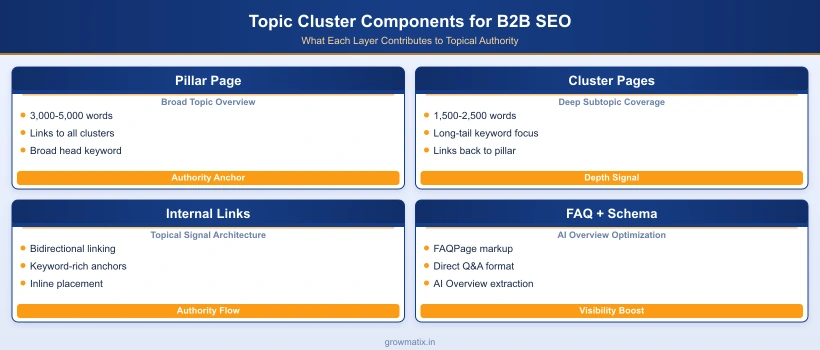
Pillar Page Content Requirements
The pillar page is the one page in the cluster that a buyer can read to understand the entire topic area. It is not the deepest page in the cluster; it is the broadest. Content requirements:
- Breadth over depth: Cover every major subtopic at a 200 to 400 word summary level. Save the depth for cluster pages.
- Comprehensive FAQ section: 5 to 8 FAQ items addressing the most common questions across all subtopics in the cluster. This is a primary AI Overview inclusion signal.
- Comparison tables: Where multiple options exist (tools, strategies, frameworks), include a comparison table. Tables increase time on page and are frequently extracted into featured snippets.
- Outbound links to cluster pages: Every cluster page must be referenced and linked from the pillar with a clear description of what additional depth the reader will find there.
- Word count target: 3,000 to 5,000 words for competitive B2B topics. This is driven by content coverage requirements, not an arbitrary word count rule.
Cluster Page Content Standards
Cluster pages earn their position in the cluster by going deeper on their subtopic than any comparable standalone post. The test: after reading the cluster page, should the reader need to go anywhere else to understand this subtopic fully? If the answer is yes, the page needs more depth.
- Narrow keyword focus: One primary keyword, 3 to 5 semantic variations as secondary targets
- Implementation detail: How-to steps, tool-specific workflows, or worked examples that the pillar page summarizes but doesn’t provide
- Link back to pillar: One contextual reference to the pillar page, naturally placed in the introduction or in a relevant body section
- Link to related cluster pages: One or two contextual links to other cluster pages in the same cluster where the subtopics directly connect
- Schema markup: Article + FAQPage + BreadcrumbList, consistent with the pillar
Content Types That Work Best in B2B Clusters
| Content Type | Best Position in Cluster | Primary SEO Value |
|---|---|---|
| Comprehensive pillar page | Cluster center | Broad keyword authority, AI Overview inclusion |
| How-to implementation guide | Cluster page | Long-tail process queries, HowTo schema |
| Tool comparison page | Cluster page | Commercial intent, high conversion rate |
| Case study or results page | Cluster page | E-E-A-T signal, bottom-funnel intent |
| FAQ-focused post | Cluster page | PAA capture, AI Overview extraction |
| Definition/glossary post | Cluster page | Top-of-funnel, knowledge panel signals |
B2B Topic Cluster Mistakes That Limit Rankings
Most topic cluster programs that fail to drive rankings make one of three structural mistakes. Understanding them in advance prevents the need to rebuild the cluster after publishing.
Building Clusters Around Traffic Volume Instead of Buyer Intent
The most common mistake is selecting pillar topics and cluster keywords based on monthly search volume rather than commercial relevance. A B2B topic cluster optimized for high-volume terms that attract researchers rather than buyers will drive traffic that never converts into pipeline.
The correct filter is intent, not volume. A pillar topic that generates 400 monthly searches but maps to a product category your sales team actively closes is worth more than a pillar topic generating 4,000 monthly searches from a tangentially related audience. Use intent qualification in keyword research: filter for keywords that include commercial signals (“best,” “vs,” “pricing,” “how to choose”) alongside informational signals (“what is,” “how does,” “guide to”) to build clusters that serve buyers at every stage without drifting into purely academic traffic.
Internal Linking Left as a Post-Publishing Afterthought
Internal links added after publishing, especially those injected via sidebar widgets or automated related post plugins, carry far less SEO weight than contextual inline links placed within the body content during original drafting. A cluster page published without a contextual link back to the pillar misses the primary mechanism through which the cluster generates topical authority.
Build the internal linking map before writing begins, not after. Every cluster page brief should specify the exact sentence and anchor text where the pillar page link will be placed. Similarly, the semantic SEO and topic clusters connection is why each new cluster page should also link to semantically adjacent cluster pages where the topics genuinely connect, further strengthening the topical neighborhood signal.
Neglecting Pillar Page Updates as Cluster Content Expands
A pillar page published when the cluster has 3 cluster pages needs to be updated when the cluster reaches 10. The pillar should reference and link to every cluster page. A pillar that only links to the first few cluster pages published sends a weaker topical signal than one that references the full scope of cluster coverage.
Schedule quarterly pillar page reviews as a fixed part of cluster maintenance. Update the content to reflect new cluster pages published since the last review, add internal links to new cluster pages, and refresh external citations to ensure referenced data remains current. Pillar pages that are updated regularly consistently outperform those that are published once and left static.
Measuring Topical Authority Gains from Your Content Cluster
Topical authority is not directly measurable as a single metric. It manifests across several signal types that are individually measurable in Google Search Console and GA4. Tracking these metrics across the cluster, rather than per-page, gives an accurate picture of whether the cluster is building authority or plateauing.
Organic Impressions as a Topic Coverage Signal
In Google Search Console, filter by the pillar page URL and export the query report. As the cluster grows and internal link equity flows through the cluster, the number of distinct keyword queries generating impressions for the pillar page should increase. A pillar page for “B2B content strategy” that generates impressions for 200 distinct query variations after 6 months is demonstrating broader topical coverage than one generating 40 variations. This expansion of the keyword impression footprint is the earliest measurable signal of topical authority growth, typically visible before ranking changes occur.
Track this metric monthly: total impressions across all cluster pages, number of distinct queries generating at least 10 impressions, and average position for the top 20 cluster keywords. A healthy cluster shows all three metrics trending upward over a 6-month window.
Ranking Position Changes Across Cluster Keywords
Position tracking for a topic cluster should cover the full keyword set, not just the pillar keyword. Use a rank tracker to monitor positions for the primary keyword of each cluster page alongside the pillar keyword. A well-performing cluster shows correlated ranking improvements: when the pillar page ranking improves, cluster page rankings for related keywords improve in parallel. This correlation is the topical authority effect in action.
Establish a 90-day rolling baseline for each cluster keyword at launch. Measure position changes at 30, 60, and 90 days. Most B2B clusters do not show meaningful ranking movement before 60 days. Position improvements appearing before 30 days are typically due to crawl and indexation speed, not topical authority building.
Pipeline Attribution for B2B Cluster Content
The ultimate measure of a B2B topic cluster is organic pipeline generated, not keyword rankings. Connecting the cluster to revenue requires three attribution steps:
- Tag all cluster URLs in GA4 as a content group so organic sessions to any cluster page are measured as a unit, not as individual page sessions.
- Set up goal events for organic-sourced form fills, demo requests, and contact page visits attributed to cluster page sessions. Use GA4’s event-scoped custom dimensions to capture the source cluster for each conversion event.
- Map GA4 goal completions to CRM opportunity creation by matching UTM parameters or first-touch source data. This closes the attribution loop from organic session through to pipeline value.
Most B2B content teams stop at traffic and rankings. Teams that build the attribution chain from cluster session to CRM opportunity have a defensible data story for content investment that traffic metrics alone cannot provide. The SEO services team at Growmatix builds this attribution infrastructure as part of every content cluster engagement, connecting organic channel performance directly to revenue reporting from day one.