



Semantic SEO: The Complete Guide to Ranking in 2026
Table of content
Search engines no longer rank pages based on how many times a keyword appears. They rank based on meaning, context, and authority. That shift is the foundation of semantic SEO, and in 2026, it is no longer optional for businesses that want to grow online.
This guide breaks down exactly what semantic SEO is, how Google and Bing process meaning, and the step-by-step strategies you need to rank higher, earn featured snippets, and get cited by AI tools like ChatGPT, Claude, Perplexity, and Google AI Overviews.
What Is Semantic SEO?
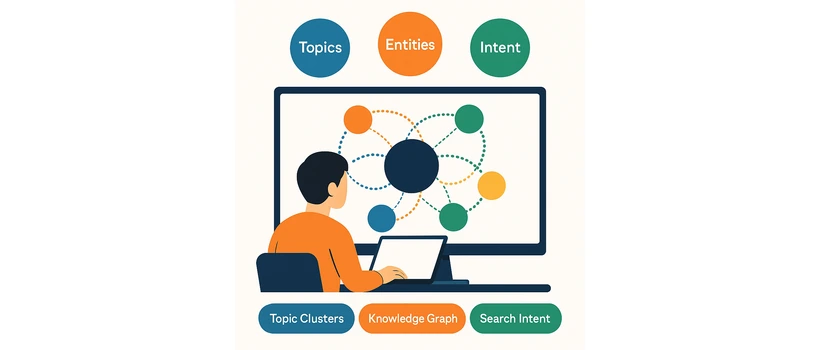
Semantic SEO is the practice of optimizing content around topics, entities, and user intent, rather than targeting isolated keywords. It aligns your content with how modern search engines actually understand language: through relationships between concepts, not just word matches.
Traditional SEO asked: “What keyword should I rank for?”
Semantic SEO asks: “What does a user actually need, and how do all the related concepts connect?”
For example, a page about “best CRM software for B2B companies” semantically relates to topics like lead management, sales pipeline, SaaS pricing, customer retention, and marketing automation. A semantically optimized page covers these related concepts naturally, not by stuffing keywords, but by building genuine topical depth.
How Search Engines Evolved to Understand Meaning
To understand why semantic SEO works, you need to understand how Google’s algorithm evolved.
Google Hummingbird (2013): The First Shift to Meaning
Hummingbird was Google’s first major step away from exact-match keyword ranking. It enabled the engine to interpret full sentences and conversational queries, understanding intent, not just individual words.
RankBrain (2015): Machine Learning Enters Search
RankBrain introduced machine learning to search, allowing Google to interpret never-before-seen queries by mapping them to conceptually similar ones. It could understand that “affordable CRM for small teams” and “low-cost sales software for startups” mean the same thing.
BERT (2019): Understanding Context in Full Sentences
BERT (Bidirectional Encoder Representations from Transformers) gave Google a deep understanding of context within sentences. A small preposition like “for” or “without” could now change how a result was ranked. BERT made it possible to understand nuanced, long-tail, and conversational queries at scale.
MUM and Generative AI (2021-2026): Multimodal, Entity-First Search
Google’s MUM model and its AI Overviews feature process queries across text, images, and video simultaneously. As of 2026, AI Overviews trigger for a significant portion of all search queries in the US, and they pull from content that is semantically structured, entity-rich, and authoritative.
What Is the Google Knowledge Graph and Why Does It Matter?
The Google Knowledge Graph is a database of entities and the relationships between them. Launched in 2012 with 570 million entities, it has grown to contain over 8 billion entities and 800 billion facts.
An entity is anything that can be distinctly identified: a person, company, product, location, or concept. When Google understands that your brand, your content, and your industry are entities with clear relationships, it rewards you with higher visibility.
- Your company should be recognized as an entity in your industry
- Your content should reference authoritative entities (industry bodies, tools, concepts)
- Your schema markup should explicitly declare your entity type and attributes
Why Semantic SEO Matters for Your Business in 2026
1. AI Overviews Pull From Semantically Rich Content
Google’s AI Overviews synthesize answers from multiple pages. To be cited, your content must be structured clearly, define concepts precisely, and cover topics comprehensively. Fragmented, keyword-stuffed content is never selected.
2. LLMs Like ChatGPT and Claude Train on High-Authority Content
Language models cite pages that demonstrate expertise, cite data, define terms clearly, and structure information hierarchically. Semantic SEO best practices directly overlap with what makes content LLM-citable.
3. Single Articles Can Rank for Dozens of Keywords
When a content hub expands from single keywords to semantic keyword groups, individual articles can rank for 40 to 60 related keywords, tripling organic visibility. The same principle applies across every industry.
4. Entity-Based Optimization Drives Exponential Visibility Gains
Entity-based E-E-A-T optimization, when implemented consistently across a site’s content cluster, compounds over time. The more interconnected your entity coverage, the harder it becomes for competitors to displace individual pages.
The 5 Core Elements of Semantic SEO
1. Search Intent Alignment
Every search query has an intent. Semantic SEO begins with correctly identifying and matching that intent.
| Intent Type | What the User Wants | Example Query |
|---|---|---|
| Informational | To learn | What is semantic SEO? |
| Navigational | To find a specific site | Growmatix Digital SEO agency |
| Commercial | To compare options | Best SEO agency for B2B companies |
| Transactional | To take action | Hire SEO agency India |
2. Entity-Based Content
Entities are the nouns of the semantic web. Instead of optimizing for “SEO tips,” optimize for the entity of SEO itself: its definition, its sub-entities (on-page SEO, technical SEO, link building), and its relationships to adjacent entities (content marketing, digital marketing, SERP features).
3. Topic Clusters and Topical Authority
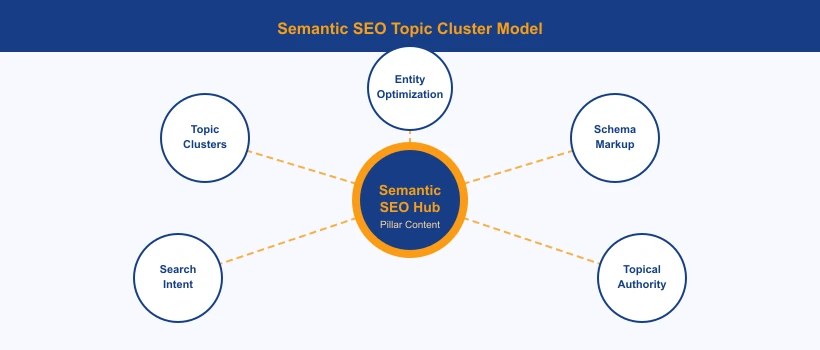
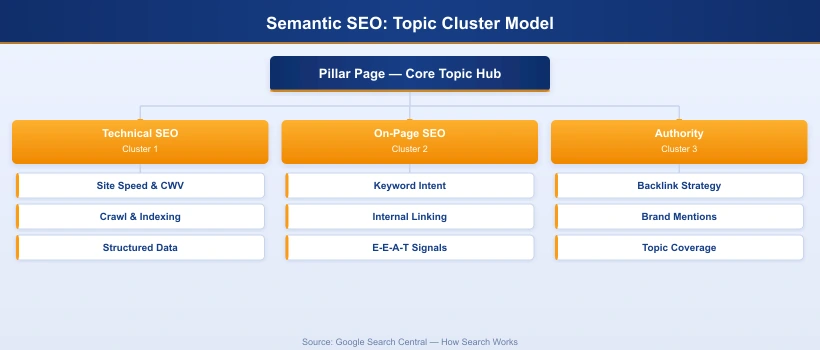
Topical authority means search engines trust your website as a reliable source on a given subject. You build it through topic clusters: a system of interconnected content organized around a central pillar page.
- Pillar Page: A comprehensive, authoritative guide on a broad topic
- Cluster Pages: In-depth articles on specific subtopics
- Internal Links: Every cluster page links back to the pillar, and the pillar links out to each cluster
4. Semantic Keyword Research
Semantic keywords are conceptually related terms that appear in the same context as your primary topic. Three types:
- Core keywords: the primary topic term (e.g., semantic SEO)
- Theme words: related concepts that add context (e.g., entity optimization, knowledge graph, search intent)
- Stem words: variations and related phrases (e.g., semantic search optimization, meaning-based SEO)
5. Structured Data and Schema Markup
Structured data is the bridge between your content and search engine understanding. Always implement JSON-LD (Google’s recommended format) for: Article, FAQPage, Organization, BreadcrumbList, and HowTo schemas.
How to Implement Semantic SEO: A Step-by-Step Strategy
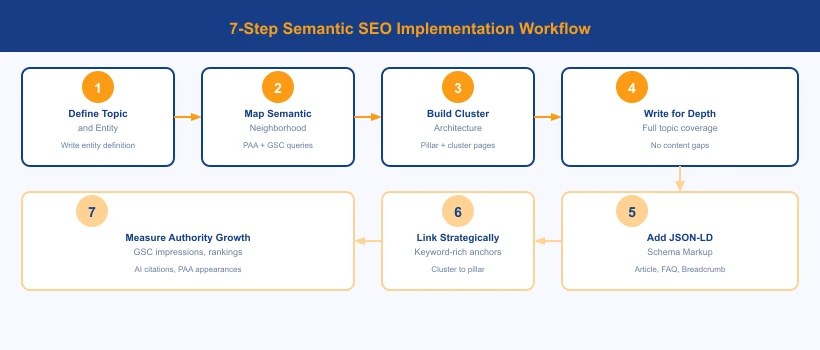
Step 1: Define Your Core Topic and Entity
Before writing, identify the primary entity your content is about. Write a one-sentence definition. This definition should appear in the first 100 words of your content.
Step 2: Map the Semantic Neighborhood
List all related entities, sub-topics, and questions that naturally belong to your topic. Use Google’s People Also Ask, AnswerThePublic, and Search Console query data to build a comprehensive map.
Step 3: Build Your Topic Cluster Architecture
Create a content map: one pillar page at the center, and five to ten cluster pages branching from it. Plan internal links before writing a single word.
Step 4: Write for Depth, Not Length
Comprehensive content is not about word count; it is about covering the topic without gaps. Address the core entity, related concepts, common questions, and real-world applications.
Step 5: Add Schema Markup Using JSON-LD
After publishing, implement JSON-LD structured data. At minimum, mark up every blog post with the Article schema and every FAQ section with FAQPage schema. This directly increases your eligibility for AI Overview citations.
Step 6: Build Internal Links Strategically
Every new piece of content should link to at least two existing pages, and at least one existing page should link to the new content. Use descriptive, keyword-rich anchor text that reflects the semantic relationship between pages.
Step 7: Measure Topical Authority Growth
- Total keyword rankings (not just primary keywords)
- Impressions in Search Console
- Featured snippet and PAA appearances
- AI Overview citations
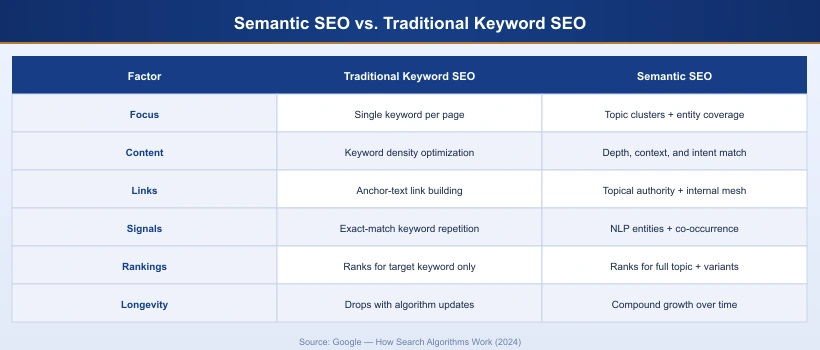
Semantic SEO vs. Traditional SEO: Key Differences
| Factor | Traditional SEO | Semantic SEO |
|---|---|---|
| Focus | Individual keywords | Topics and entities |
| Content strategy | One page per keyword | Topic clusters |
| Success metric | Rank for one term | Rank for dozens of related terms |
| Algorithm alignment | Keyword frequency | Meaning and context |
| AI search visibility | Low | High |
| Long-term durability | Low (fragile to updates) | High (aligned with algorithm direction) |
Semantic SEO and AI-Powered Search: What You Must Know in 2026
The rise of AI-generated search results has made semantic SEO more important, not less.
AI Overviews select content that:
- Clearly defines the topic entity in the first paragraph
- Uses structured headings that match question-based queries
- Includes FAQs with concise, factual answers
- Implements FAQPage schema markup
- Demonstrates E-E-A-T (Experience, Expertise, Authoritativeness, Trustworthiness)
LLMs like ChatGPT, Claude, and Perplexity cite content that:
- Uses authoritative, citation-ready statements
- Includes verifiable data points and statistics
- Structures information with clear H2/H3 hierarchies
- Covers topics comprehensively without ambiguity
Common Semantic SEO Mistakes to Avoid
1. Treating LSI Keywords as a Ranking Signal
Latent Semantic Indexing is a dated academic concept. Google does not use LSI. It uses entity relationships and intent signals. Focus on those instead.
2. Publishing Without a Topic Cluster Strategy
A standalone blog post, no matter how good, cannot build topical authority. Authority comes from consistent, interconnected coverage of a subject over time.
3. Skipping Structured Data
Schema markup is no longer optional. Without it, you leave AI Overview eligibility, rich snippets, and entity recognition on the table.
4. Matching Keywords Without Matching Intent
A page can rank briefly for a keyword but will never hold its position if the content does not deliver what the user actually needs.
5. Ignoring Internal Linking Architecture
Topic clusters only work when the internal linking structure is deliberate. Orphaned pages do not accumulate topical authority.
Conclusion
Search has fundamentally changed. Google, Bing, and AI-powered tools no longer reward pages that repeat keywords. They reward pages that understand topics, demonstrate expertise, and connect concepts the way human experts do.
Semantic SEO is not a tactic. It is a strategy that aligns your content with the direction search has been moving for over a decade. For B2B companies in particular, semantic SEO offers a sustainable competitive advantage: build topical authority in your industry, earn citations from AI tools your prospects use, and compound your organic visibility over time.
At Growmatix Digital, we help B2B brands implement semantic SEO strategies grounded in data, entity optimization, and long-term authority building. If you want to move beyond keyword rankings and build genuine search visibility, get in touch with our team.
Start with a Solid Technical Foundation
Semantic SEO strategies deliver their full potential only when the underlying technical infrastructure is sound. If you are working on a B2B site, work through our B2B technical SEO playbook first: crawl budget, Core Web Vitals, schema markup, and site architecture all influence how quickly Google surfaces your semantic content clusters.
Get Expert Help with Semantic SEO Implementation
Implementing topic clusters, entity optimisation, and semantic content structures across a large site requires both strategy and execution bandwidth. Growmatix’s SEO services team specialises in content architecture and semantic relevance strategies for B2B brands.