




Brand Mentions and Unlinked Citations: The Hidden SEO Signal
Table of content
Brand mentions that link to your website are straightforward link equity. But what about the growing volume of citations that name your brand, reference your content, or quote your research without a clickable hyperlink? These unlinked brand mentions are measurable, monitorable, and convertible, and the evidence suggests they carry SEO weight even without the anchor tag.
The practice of tracking and converting unlinked citations sits at the intersection of brand monitoring and link building. When a journalist names your company in an article without linking, a blogger quotes your research without attribution, or a forum post references your platform by name, each of those instances registers as a brand signal that search engines and AI systems can process. As part of a comprehensive B2B link building strategy, brand mention conversion is one of the highest-ROI tactics available: you are recovering value from coverage you have already earned, rather than generating it from scratch.
This guide covers the mechanics of unlinked brand mention SEO: how Google uses brand signals in its entity recognition systems, which tools surface unlinked citations at scale, the outreach workflow that converts mentions to live links, and how to measure the impact of a brand mention program over time.
What Are Unlinked Brand Mentions in SEO?
Brand Mentions vs. Backlinks: Understanding the SEO Difference
A backlink is a navigational signal: the hyperlink tells crawlers there is a directed relationship between two pages, and PageRank flows along that relationship. An unlinked brand mention is a co-occurrence signal: the name appears in context without a navigational connection, but the text still establishes a semantic relationship between your brand and the topic being discussed. Both signal types matter in modern search, but they operate through different mechanisms.
| Signal Type | SEO Mechanism | Direct Link Equity | Primary SEO Benefit |
|---|---|---|---|
| Backlink (linked mention) | PageRank transfer via hyperlink graph | Yes | Domain authority, ranking on target pages |
| Unlinked brand mention | Entity recognition, co-occurrence signals | No | Brand entity strength, topical association |
| Co-citation | Topical association via repeated co-occurrence | No | Entity classification, AI citation visibility |
| Converted mention (link recovered) | PageRank transfer after outreach | Yes | All backlink benefits, plus entity reinforcement |
The practical distinction matters for prioritization. Backlinks transfer PageRank directly and contribute to domain authority metrics in tools like Ahrefs and Semrush. Unlinked mentions influence entity recognition, brand entity strength, and the co-occurrence patterns that search engines use to build topical associations. A brand mention conversion program pursues both outcomes: using monitoring to find unlinked citations, then recovering them as full backlinks through outreach while capturing entity signal value in the interim.
Co-Citation SEO and Entity Association Signals
Co-citation is the phenomenon where two entities are frequently referenced together across multiple independent sources, even without direct links between them. In academic citation analysis, co-citation established connections between research papers that cited the same sources. In web search, the principle applies to brands: when your company is consistently mentioned alongside specific tools, topics, or industry terms across authoritative editorial content, search engines build semantic associations that influence how your brand entity is classified and ranked.
For B2B brands, co-citation signals compound over time. A cybersecurity company mentioned repeatedly in the same articles as SIEM tools, threat intelligence platforms, and zero-trust architecture builds topical authority in that domain through entity association, not just through links pointing to its pages. According to Google’s documentation on how search organizes information, its systems analyze relationships between entities and topics across the web to understand context and relevance, a process that co-occurrence data directly feeds into.
Co-citation also matters for AI-powered search systems. Large language models trained on web corpora learn topical associations from repeated co-occurrence in editorial text. A brand mentioned consistently in authoritative contexts alongside relevant industry terms is more likely to appear in AI-generated answers on those topics. Monitoring and growing unlinked citation volume is therefore both a traditional SEO tactic and an emerging LLM visibility strategy.
Do Brand Mentions Help SEO Without Links?
Brand Signals and Google’s Knowledge Graph
Google’s Knowledge Graph is a structured database of entities, their attributes, and the relationships between them. For brands, the Knowledge Graph stores information about what a company does, who it serves, what topics it is authoritative on, and how it relates to other entities in the same space. The data that feeds this graph comes from multiple sources: structured schema markup, Wikipedia and Wikidata, official social profiles, and editorial co-occurrence signals from across the web.
Unlinked brand mentions contribute to the third category. When authoritative editorial sources reference your brand in specific topical contexts, the co-occurrence data reinforces entity attributes in Google’s systems. The effect is particularly pronounced for brands that do not yet have a Knowledge Panel: consistent unlinked citation volume in authoritative contexts can accelerate the entity recognition process that eventually produces one.
Practically, the SEO impact of brand signals manifests in two measurable ways:
- Branded query impressions: As brand entity strength grows, Google Search Console shows increasing impression volume on branded queries, even without active link building targeting those keywords.
- Topical relevance lift: Pages on your site covering topics where your brand is heavily cited editorially can see improved rankings for those topic clusters, driven partly by entity association signals rather than solely by on-page optimization or link equity.
According to Ahrefs’ analysis of unlinked brand mentions, while unlinked mentions do not transfer direct link equity, they represent a significant opportunity for link recovery: for many established brands, the volume of unlinked citations exceeds the volume of linked ones, making systematic mention monitoring and outreach a high-leverage activity relative to the effort of cold outreach link building.
Unlinked Citations in AI Training Data and LLM Visibility
The relevance of unlinked brand mentions has increased significantly with the rise of AI-powered search. ChatGPT, Perplexity, Google’s AI Overviews, and similar systems generate answers from training data and retrieval-augmented generation, where the quality and frequency of editorial citations in web text directly influences which brands and sources appear in AI-generated answers.
Unlike classic PageRank, which operates on the hyperlink graph, language model training operates on text co-occurrence and semantic associations. A brand that appears frequently in authoritative editorial content alongside relevant queries and topics is more likely to be recalled as a relevant entity when those topics come up in AI queries. The hyperlink is irrelevant to this mechanism; what matters is the editorial text itself.
This creates a strategic shift in how brand mention monitoring should be framed. For traditional SEO, the primary value of an unlinked mention is as a conversion target: find it, request the link, recover the link equity. For AI search visibility, the unlinked mention has independent value as training signal. Both use cases argue for maximizing the breadth and authority level of brand citations across the web, whether or not all of them are ever converted to linked attributions.
For B2B brands actively building off-page authority through earned media, the tactics covered in a strong digital PR for B2B companies program generate exactly the type of authoritative editorial citations that feed both traditional brand signals and AI citation models.
How to Monitor Unlinked Brand Mentions for SEO
Brand Mention Monitoring Tools: Google Alerts, Ahrefs, and Mention
Effective brand mention monitoring requires layering multiple tools, because no single platform captures the full universe of online citations. The core monitoring stack for B2B brands combines a free alert system for broad coverage with a paid SEO tool for authority-filtered results and, optionally, a dedicated monitoring platform for social and real-time volume.
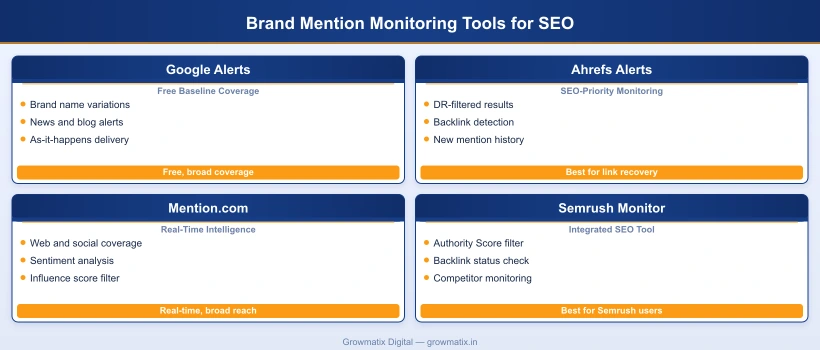
| Tool | Coverage | SEO Filtering | Best For | Cost |
|---|---|---|---|---|
| Google Alerts | Web, news, blogs | None | Broad coverage baseline, new content alerts | Free |
| Ahrefs Alerts | Web, news, indexed pages | DR filter, backlink detection | SEO-priority outreach, DR-filtered opportunities | Included with Ahrefs plan |
| Mention.com | Web, social, forums, news | Sentiment, reach, influence score | Real-time monitoring, social listening | Paid (from ~$49/mo) |
| Semrush Brand Monitoring | Web, news, social | Authority Score, sentiment, backlink status | Integrated SEO + brand intelligence | Included with Semrush plan |
For most B2B brands, the practical starting point is Google Alerts for immediate alerts on new mentions and Ahrefs Alerts for authority-filtered results that are worth outreach investment. The combination covers the majority of editorial content that matters for SEO without requiring a separate dedicated monitoring subscription.
Setting Up a Systematic Brand Mention Monitoring Program
The configuration of your monitoring alerts determines the quality of the opportunity pipeline you generate. Most brands set up alerts for their company name only, which misses a significant percentage of mentions that use product names, abbreviations, executive names, or common variations.
A complete monitoring setup for a B2B brand should include alerts for:
- Company name variations: Full legal name, trading name, common abbreviations, and the most frequent misspelling of your brand name.
- Product and platform names: Named products or features that have independent search volume separate from the company brand.
- Key executive names: Founder, CEO, and any spokespersons who appear in media coverage. Executive mentions without company name context still represent brand citations that can be linked to your about or team pages.
- Domain name without protocol: Setting an alert for your domain (e.g., “yourdomain.com” without “https://”) catches articles that reference your site without creating a hyperlink.
- Branded phrases: Proprietary methodologies, named frameworks, or trademarked terms specific to your company.
Set Google Alerts to “As it happens” frequency during the initial setup period to calibrate signal volume, then switch to weekly digest once you understand the typical volume. In Ahrefs Alerts, set the DR threshold at 20 or higher to filter out low-authority content and focus outreach effort on mentions worth pursuing. Collect and review results weekly, scoring each mention against three criteria before entering it into your outreach queue: domain authority, article recency (within 6 months is the realistic conversion window), and how directly the mention creates a natural context for a link.
How to Convert Unlinked Brand Mentions to Backlinks
The Mention-to-Link Outreach Process
Converting an unlinked mention to a live backlink requires a structured outreach process that is brief, specific, and framed entirely in terms of value for the publication’s readers, not benefit for your brand. The approach that achieves the highest conversion rate is also the most direct.
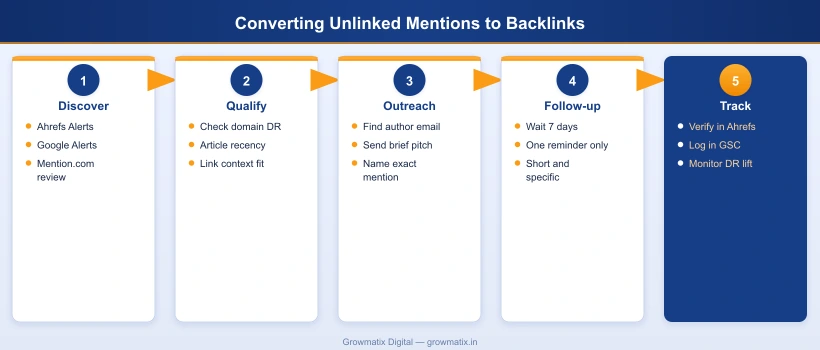
- Discover and score the mention. Use your monitoring stack to identify the unlinked citation. Before outreach, verify the article is live, the domain has a DR/DA above your minimum threshold (typically 20-30 for B2B), and the mention is recent enough that the editor is likely still reachable. Articles over 12 months old have significantly lower conversion rates than recent coverage.
- Identify the correct contact. The article author is the first contact target, not the publication’s general inbox. Use the author’s name from the byline to find their email via Hunter.io, Clearbit, or LinkedIn. If the author is no longer at the publication, target the section editor. Never use generic contact forms for link requests; they are rarely actionable by someone with authority to edit published content.
- Draft a concise, specific outreach email. Reference the exact article title and the sentence where your brand appears. Explain why adding a link benefits the reader (“allows readers to verify the data directly” or “gives readers access to the resource you referenced”). Keep the email under 120 words. Do not pitch your brand, explain your value proposition, or include any promotional content. The goal is a single editorial action, not a relationship pitch.
- Send and wait before following up. Send the initial outreach and wait at least seven days before a single follow-up. The follow-up should be one or two sentences that reference the original email and restate the specific ask. Do not send more than one follow-up per mention. Persistent outreach damages sender reputation and closes the door on the publication permanently.
- Verify and track confirmed links. When a link is placed, verify it using Ahrefs > Backlink Checker or Google Search Console > Links > External Links to confirm the link is crawlable and pointing to your intended destination. Log the domain, placement date, and target URL in a tracking sheet. Monitor for link removal quarterly.
Realistic conversion benchmarks vary by brand visibility and publication type. According to Moz’s analysis of link building outreach, personalized outreach campaigns for link recovery typically convert at higher rates than cold outreach because the recipient already has a relationship with the brand as a reference point, even if that relationship is as minimal as having mentioned the brand once in passing.
Outreach Framing and Response Rate Optimization
The framing of your outreach email determines whether it is read as a reasonable editorial request or a link scheme solicitation. These are the principles that consistently produce higher response rates for mention-to-link outreach:
- Lead with the article, not your brand. Open with the article title and why you found it useful. The first line should make the editor feel the email is from a reader, not an SEO. “I read your piece on [topic] in [publication] and noticed you referenced our research on [specific topic]” establishes context without sounding transactional.
- Name the specific sentence or paragraph. “In the section on [topic], you mention [company name] in the context of [claim]” is more compelling than “I noticed a mention of our brand.” Specificity signals that a human wrote the email rather than a mass outreach tool.
- Frame the link as a reader service. “Adding a link to our [page type: research / tool / methodology] would let your readers access the source directly” is the highest-conversion framing because it is true and positions the action as an editorial improvement rather than a favor to you.
- Make the specific page easy to confirm. Include the exact URL you are requesting the link to. Do not make the editor guess which page is the right destination. If the mention is in context with a specific resource, link to that resource, not to your homepage.
- Match the tone of the publication. A casual tech blog warrants a different email register than a formal trade publication. Read three articles on the publication before writing the outreach. Mirror the formality level of the publication’s editorial voice.
Subject lines that reference the specific article title consistently outperform generic subjects like “Backlink request” or “Quick question.” A subject line of “Re: [Article Title] – a small edit” reads as an editorial follow-up rather than a solicitation and typically achieves higher open rates for this type of outreach.
Measuring the SEO Impact of Your Brand Mention Program
Key Metrics to Track for Brand Mention SEO
A brand mention program generates two categories of measurable SEO output: direct link acquisition metrics (measurable immediately after conversion) and brand signal metrics (measurable over longer time horizons as entity recognition strengthens). Tracking both categories is necessary to accurately attribute SEO value to the program.
| Metric | What It Measures | Where to Track | Reporting Cadence |
|---|---|---|---|
| Unlinked Mentions Identified | Volume of citation opportunities in monitoring queue | Ahrefs Alerts, Mention.com, Google Alerts | Weekly |
| Outreach Conversion Rate | Percentage of outreach emails resulting in placed links | Internal tracking sheet | Monthly |
| New Referring Domains (from conversions) | Count of new linking domains added via mention recovery | Ahrefs, Semrush | Monthly |
| Branded Query Impressions | GSC impressions on branded queries as proxy for entity strength | Google Search Console | Monthly, trend over 3-6 months |
| Domain Rating / Authority Score | Aggregate domain authority influenced by converted links | Ahrefs DR, Semrush AS | Quarterly |
| AI Citation Appearances | How often brand appears in relevant ChatGPT / Perplexity queries | Manual sampling, AI search monitoring tools | Quarterly |
In Google Search Console > Links > External Links > Top linking sites, newly converted mentions appear as new linking domains within 2-4 weeks of the link being placed, depending on how frequently the publication is crawled. Tracking GSC link acquisition monthly allows you to attribute converted mentions directly to DR improvements over time.
Calculating ROI from Mention-to-Link Conversion Campaigns
The economic case for a brand mention monitoring program is straightforward to construct because the alternative cost is well-defined: how much would it cost to acquire equivalent links through cold outreach link building?
A reasonable ROI calculation framework for a quarterly brand mention program:
- Establish the monitoring and outreach cost. This is the hourly cost of the team member managing monitoring and outreach, multiplied by hours invested per quarter. A systematic program for a mid-size B2B brand typically requires 3-5 hours per week: monitoring review, opportunity scoring, email drafting, and follow-up management.
- Calculate the link equivalent value. Using your average cost-per-link from other link building tactics (guest posting, digital PR, resource page outreach), assign a value to each converted mention link. If your average cost to acquire a DR 40+ link through other means is $400-600, each converted mention link at the same authority level represents that avoided cost.
- Track entity signal value separately. Unlinked mentions that were not converted still contribute entity signal. These are harder to value directly, but the growth in branded query impressions in GSC provides a proxy. A 20-30% increase in branded impressions over two quarters in a period of active mention building can be directionally attributed to the program.
According to Semrush’s brand monitoring research, brands that run systematic mention monitoring alongside active link building programs see stronger domain authority growth than those pursuing link acquisition alone, because the combination builds both the link graph and the entity signal layer simultaneously.
For B2B organizations building a scalable off-page SEO program, brand mention monitoring belongs in the same priority tier as link building outreach and digital PR. The unique advantage is efficiency: unlike cold outreach, every mention in your monitoring queue is a warm lead from a source that has already chosen to reference your brand. The conversion work is straightforward. The compounding effect on entity recognition over 12-24 months of consistent program operation is meaningful, particularly as AI-powered search continues to expand the weight given to editorial brand signals relative to pure link graph metrics.