




E-E-A-T for B2B Brands: How to Build Trust With Google
Table of content
E-E-A-T is not a ranking algorithm. It is a standard. Google’s Search Quality Rater Guidelines define what “high-quality content” means to the humans who evaluate search results and, by extension, to the systems that incorporate those evaluations into ranking signals. For B2B brands competing on commercial and informational queries, understanding this standard is the difference between organic content that builds pipeline and content that gets bypassed in favor of more authoritative competitors.
This guide covers E-E-A-T for B2B brands specifically: what each dimension means in a B2B context, which signals Google evaluates, and how to implement improvements systematically across your content program. If you are building the broader organic strategy alongside E-E-A-T, the B2B content SEO strategy covers how E-E-A-T fits into your full keyword and topic architecture.
What E-E-A-T Means for B2B Brands
The Four Dimensions of E-E-A-T Explained
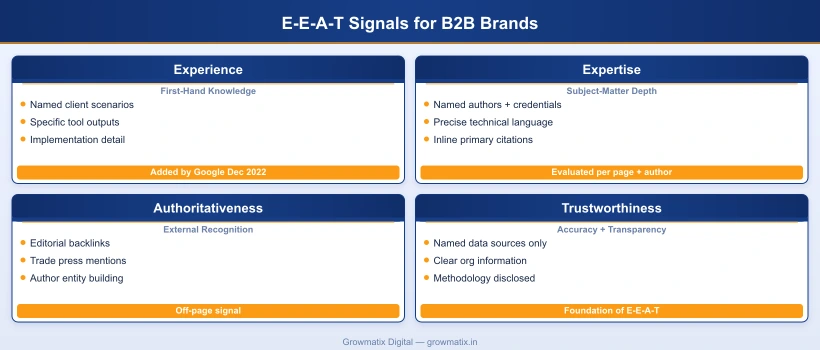
Google’s Search Quality Rater Guidelines, which describe E-E-A-T in detail, are publicly available and worth reading directly. The guidelines define quality across four dimensions that B2B brands need to operationalize:
- Experience: Does the content reflect genuine first-hand experience with the subject? For B2B brands, this means content authored by practitioners who have implemented the strategies, used the tools, or worked directly in the industry, not content that summarizes what other sources have written. A B2B SEO agency writing about technical audits should demonstrate experience through real audit findings, specific tool outputs, and named methodologies developed through client work.
- Expertise: Does the content show depth of subject-matter knowledge? For B2B brands, expertise is signaled through precise technical language used correctly, accurate descriptions of complex processes, citations to primary research, and the ability to address edge cases that only a genuine practitioner would encounter. Generic explanations that stop at the conceptual level without implementation detail signal low expertise to quality raters.
- Authoritativeness: Is the content creator or the site recognized as an authority in the topic area by others in the field? Authoritativeness is primarily an off-page signal: backlinks from recognized publications, author bylines on third-party sites, brand mentions in authoritative editorial contexts, and citations in industry research. A B2B brand can have high expertise and low authoritativeness if that expertise has not been externally recognized yet.
- Trustworthiness: Is the content accurate, transparent, and safe to act on? For B2B brands, this includes factual accuracy, clear organizational information, named contact details, transparent methodology for any data presented, and absence of misleading claims. Trustworthiness is the foundation: Google’s guidelines note that a page with low trust cannot have high E-E-A-T regardless of its expertise signals.
The “Experience” dimension was added to the framework in December 2022 according to Google’s Search Central blog (December 2022). The addition specifically recognizes that hands-on, first-person knowledge produces different content than aggregated third-person summaries, and that both formats can be appropriate depending on context. For B2B brands where practitioners are the intended authors, this addition reinforces the case for expert-authored content over generalist writers.
Why E-E-A-T Is Not a Direct Ranking Factor but Still Drives Rankings
Google has stated explicitly that E-E-A-T is not a direct ranking signal in the sense of a numeric score applied to pages. It is an evaluation framework used by human quality raters, whose assessments inform how Google’s automated systems are trained and calibrated. The practical consequence is the same: content that quality raters consistently rate as low-E-E-A-T performs worse in rankings because the algorithms have been tuned to deprioritize content patterns associated with low quality evaluations.
Google’s helpful content updates (2022-2024) specifically targeted content that “doesn’t demonstrate first-hand expertise and depth of knowledge.” According to Google’s helpful content documentation, content that is primarily created to rank rather than to genuinely help readers is identified by signals that overlap substantially with low E-E-A-T: lack of original analysis, absence of named authorship, no first-hand experience signals, and content that simply restates what is already available elsewhere.
For B2B brands, the implication is clear: improving E-E-A-T improves rankings not through a direct signal but through producing content that Google’s systems have been trained to recognize as higher quality.
Building Experience Signals for B2B Content
What First-Hand Experience Looks Like in B2B Content
The Experience dimension is where most B2B brands have the largest improvement opportunity. The majority of B2B content is written in the third person, describes strategies at a conceptual level, and avoids specific implementation detail that would expose the author to scrutiny. This pattern is recognizable to quality raters as low-experience content, regardless of how well-written it is.
High-experience B2B content has specific, verifiable characteristics:
- Named tool outputs with specific values. Instead of “monitor your Core Web Vitals,” a practitioner writes: “In our audit of a 12,000-page B2B SaaS site, the LCP value was 4.2 seconds driven by an unoptimized hero image. After preloading the image and converting to WebP, LCP dropped to 1.9 seconds across mobile. The change moved the page from Poor to Good threshold in Chrome DevTools > Lighthouse > Performance within 48 hours of deployment.” That level of detail is only possible from someone who ran the audit.
- Decision-point nuance. Experience shows when content addresses the non-obvious choices: when to use a server-side render instead of lazy loading, which Ahrefs metric to prioritize when domain rating and URL rating diverge, how to handle redirect chains when site migration timelines are compressed. Generic guides skip these decision points; practitioner content covers them because practitioners encounter them.
- Failure cases and edge conditions. High-experience content acknowledges what does not work and under which conditions. “This approach works for sites with clean crawl architecture, but fails predictably on large e-commerce sites with faceted navigation unless combined with canonical tag management.” Failure acknowledgment signals that the author has tested the approach and observed its limits.
Author Profiles as Experience Signals
Named authorship is the clearest way to associate Experience and Expertise signals with specific content. Google evaluates author entities: named individuals with verifiable credentials, external profiles, and content history across multiple platforms. An anonymous corporate blog post cannot carry author E-E-A-T signals; a post by a named practitioner with a LinkedIn profile, industry certifications, and verifiable work history can.
For B2B brands, implementing author E-E-A-T requires:
- Create individual author profile pages for each content contributor, including role, years of experience, industry certifications, and links to LinkedIn and any third-party publications.
- Add author schema markup (Person type) to every post, linked to the author’s profile page URL as the @id anchor.
- Build author entity presence externally: guest posts on industry publications, speaker profiles at industry events, LinkedIn articles, and participation in recognized community forums where the author’s name appears in context.
- Attribute quotes and analysis to specific team members within content rather than always writing as the collective company voice. “Our technical team lead found that…” with a named person creates an entity association that “we found that…” does not.
Demonstrating Expertise in B2B Content
Terminology Precision as an Expertise Signal
Expertise is signaled at the word level. Quality raters assess whether the author uses technical terminology correctly and at the appropriate depth for the claimed expertise level. In B2B contexts, this means using the precise terminology of the specific industry vertical, not a generalist approximation of it.
Consider the difference in these two descriptions of the same concept:
- Low expertise: “Make sure your website loads fast so search engines can rank it better.”
- High expertise: “Reducing Time to First Byte (TTFB) below 200ms for your critical landing pages removes a pre-render bottleneck that delays both Largest Contentful Paint and First Input Delay scoring in Chrome’s field data. For B2B sites on shared hosting, moving to a CDN-served static cache for marketing pages is typically the fastest path to TTFB compliance.”
The second version contains multiple expertise markers: named metrics (TTFB, LCP, FID), correct causal relationships (TTFB affects downstream CWV metrics), context-specific guidance (shared hosting vs CDN), and an actionable recommendation that a non-expert could not have generated without hands-on testing.
Citing Primary Sources to Reinforce Expertise
According to Ahrefs’ analysis of E-E-A-T and SEO, one of the clearest expertise signals is inline citation of primary sources at the exact point where claims are made. A sentence like “keyword research tools vary significantly in their data freshness and coverage methodology” has no expertise signal. The same sentence followed by a link to Ahrefs’ or Semrush’s methodology documentation, with a specific reference to how their crawler update frequency differs, demonstrates expert familiarity with both tools.
The citation format matters. External links placed in a bibliography at the end of a post provide minimal E-E-A-T value because they are not associated with specific claims. Citations embedded inline at the claim level, as described in Google’s quality rater guidelines’ examples of high-quality content, demonstrate that the author is aware of the specific source that validates a specific assertion. This is how practitioners cite sources; this is what quality raters are trained to look for.
| E-E-A-T Dimension | Weak Signal (Low Score) | Strong Signal (High Score) |
|---|---|---|
| Experience | Third-person summaries of industry practices; no implementation detail | Named client scenarios, specific tool outputs, failure cases documented |
| Expertise | Generic terminology; claims without supporting logic; no named metrics | Named metrics used correctly; precise causal relationships; edge-case coverage |
| Authoritativeness | No backlinks from recognized publications; anonymous authorship | Editorial coverage in vertical trade press; named authors with external profiles |
| Trustworthiness | Unattributed statistics; missing contact info; no methodology disclosure | Named sources for all data; clear organizational info; transparent methodology |
Content Depth Requirements for B2B Expertise
Expertise is also demonstrated through coverage completeness. A guide that addresses only the obvious dimensions of a topic signals lower expertise than one that covers implementation nuance, common failure modes, tooling specifics, and cross-functional dependencies. For B2B SEO content specifically, this means:
- Covering both the strategic rationale and the technical implementation of every recommendation
- Addressing how recommendations interact with each other (e.g., how topic cluster architecture affects crawl budget allocation, not just each individually)
- Specifying under which conditions a recommendation applies versus when an alternative approach is preferable
- Referencing current tool interfaces accurately (outdated screenshots signal that content has not been maintained by someone actively using the tools)
Building Authoritativeness for B2B Brands
Digital PR as an Authoritativeness Strategy
Authoritativeness is the most externally dependent of the four E-E-A-T dimensions. It cannot be built entirely within your own site because it is determined by what the broader web says about your brand and authors. The most effective B2B strategy for building authoritativeness combines digital PR for building B2B authority with original research publication.
The core digital PR activities that build Authoritativeness for B2B brands:
- Reactive PR with expert commentary. Services like HARO (Help a Reporter Out) and Qwoted connect journalists with expert sources. Responding to journalist queries with precise, on-the-record expert commentary builds named author citations in editorial publications. A single high-quality placement in Search Engine Journal, Forbes, or an industry trade publication creates an external authority signal that reinforces on-page expertise claims.
- Original research and data reports. Publishing proprietary research, benchmark reports, or anonymized platform data creates shareable assets that generate editorial citations. An “Annual B2B SEO Benchmark Report” from a verified methodology becomes a citable source for other content creators, building Authoritativeness through the citation count over time. According to Moz’s research on link acquisition, original research consistently earns more referring domains per published piece than any other content type.
- Industry conference and event presence. Speaker profiles on recognized industry event websites create entity associations between named team members and authoritative industry contexts. Google’s quality guidelines explicitly reference “reputation of the website and content creators” as an authoritativeness signal, which includes indexed speaker profiles, panel recordings, and event-site author pages.
- Third-party platform profiles for authors. LinkedIn profiles, Google Scholar profiles for research-focused contributors, and platform-specific author pages (e.g., Search Engine Land contributor pages) create external entity nodes that reinforce the author entity associations Google builds from content across the web.
Backlink Quality Over Quantity for B2B E-E-A-T
For E-E-A-T purposes, backlink quality matters far more than backlink quantity. Ten links from recognized B2B trade publications in your specific vertical carry more authoritativeness signal than a thousand links from generic directories or unrelated blogs. The reason is entity relevance: Google’s systems evaluate not just that you have links but whether the linking entities are recognized authorities in the same subject domain.
B2B brands should build backlinks with these quality criteria:
- Topical relevance: The linking publication covers the same domain as your content. A B2B marketing firm getting cited in Search Engine Journal, Marketing Week, or Chief Marketing Officer carries more E-E-A-T authority than the same firm getting cited in a general business directory.
- Editorial context: The link appears within editorial content that references your brand or author in a specific context, not in a sidebar widget or generic resource list.
- Named author association: Links that cite a named author from your organization (“According to [Name], [Company]…”) build author entity authority in addition to domain authority.
Trustworthiness Signals for B2B Websites
Content Accuracy as a Trust Foundation
Trustworthiness, according to Google’s guidelines, is the most critical E-E-A-T dimension. A page can demonstrate strong experience and expertise signals but will still receive a low overall E-E-A-T score if it contains inaccurate information or misleading claims. For B2B brands, this creates a specific responsibility around data citation.
The trust rules for B2B content:
- Never publish unverified statistics. Replace vague attributions (“studies show,” “experts say,” “industry data indicates”) with named sources or directional language. “Most enterprise B2B sites struggle with crawl budget allocation on large product catalogs” is trustworthy directional language. “73% of enterprise B2B sites have crawl budget issues” requires a named, citable source to be trustworthy.
- Update statistics when sources update. A blog post citing a 2020 Ahrefs study as if it is current in 2026 signals low content maintenance and erodes trust. Add year context to all data citations and set a review calendar for posts with time-sensitive statistics.
- Disclose methodology for original data. If publishing your own research, describe the sample size, data collection methodology, and any limitations explicitly. This is a trust signal both to readers and to Google’s systems that evaluate content transparency.
Website-Level Trust Signals Google Evaluates
Trustworthiness is also evaluated at the site level, not just the page level. Google’s quality rater guidelines describe “Website Information” as a distinct evaluation category that covers organizational transparency. For B2B brands, the site-level trust signals include:
- Clear, named contact information: phone number, email, physical address (if applicable), and contact form on an accessible contact page
- Detailed About page identifying the organization’s principals, founding, service areas, and methodology
- Privacy policy and terms of service pages that are current and accurate
- Security: HTTPS enforced site-wide, no mixed content errors
- Accurate business profile information on Google Business Profile (for B2B brands with physical locations)
Schema Markup as a Trust and Expertise Signal
Structured data (JSON-LD schema) does not directly improve E-E-A-T scores, but it provides explicit signals to Google about content type, authorship, and organizational identity that support E-E-A-T evaluation. The most relevant schema types for B2B E-E-A-T are:
- Article schema with author entity: Links the content to a named Person @id, associating the article with an explicit author entity that Google can evaluate across multiple sources.
- Organization schema: Provides organizational identity (name, URL, logo, address, sameAs social profiles) that establishes the brand entity associated with all content on the site.
- Person schema on author pages: Creates explicit entity markup for each content contributor, including name, jobTitle, worksFor, sameAs links to LinkedIn and external profiles, and knowsAbout topic associations.
- FAQPage schema: Signals structured expertise in FAQ format, improving eligibility for AI Overview citations where Google surfaces direct answers from content with high E-E-A-T.
Running an E-E-A-T Audit for Your B2B Website
Assessing Your Current E-E-A-T Score by Content Category
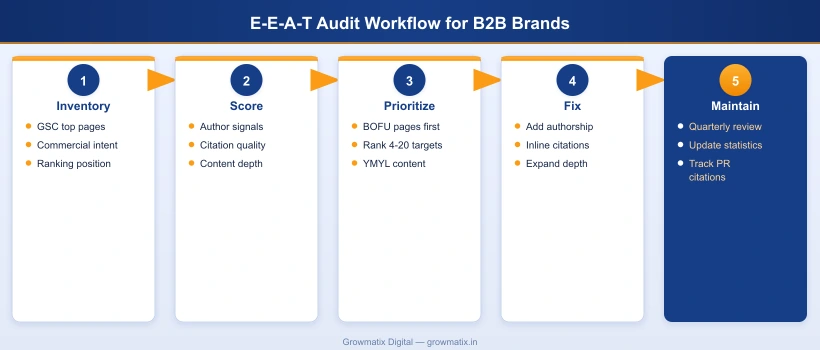
An E-E-A-T audit for B2B brands is not a single tool report. It requires a structured content review against the quality dimensions that raters evaluate. A practical audit framework:
- Inventory your top organic pages by impressions and clicks in Google Search Console > Performance > Pages. These are the pages where E-E-A-T improvements have the most ranking impact.
- Score each page across the four dimensions on a three-point scale (Strong / Weak / Missing): Does it have named authorship? Does it cite primary sources inline? Does it contain specific, verifiable implementation detail? Is all organizational information accessible from the page?
- Prioritize improvements by commercial value: Pages targeting BOFU and MOFU keywords with existing ranking positions (4-20) are the highest ROI E-E-A-T improvement targets. Moving a page from position 12 to position 5 by improving E-E-A-T signals requires less effort than building a new page to rank from scratch.
- Implement fixes in batches: Start with author attribution across all top pages (fast, high impact). Then add inline citations to pages with generic unattributed claims. Then expand content depth on pages that are shorter or shallower than their top 3 SERP competitors.
Ongoing E-E-A-T Maintenance for B2B Content
E-E-A-T is not a one-time project. Google’s helpful content updates occur repeatedly, and the quality standard for content evolves as more high-E-E-A-T content enters the competitive landscape. B2B brands that maintain a quarterly E-E-A-T review cycle consistently compound their ranking improvements, while brands that treat E-E-A-T as a one-time fix find that improvements erode over 12 to 18 months as competitors publish better content.
The quarterly E-E-A-T maintenance checklist:
- Update all time-sensitive statistics with current data from named sources
- Add Experience signals to any post published since the last review: real scenarios, specific tool outputs, or failure cases
- Check author profile pages for accuracy: current role, updated credentials, active external profile links
- Review the top 3 SERP competitors for your 10 most valuable commercial keywords and identify any E-E-A-T signals they have added since your last review
- Track digital PR placements: any new editorial citations in recognized publications should be documented and their entity associations verified in Google Search Console > Links > External Links
E-E-A-T and YMYL: Why B2B Brands Face Higher Standards
Which B2B Content Falls Under YMYL Scrutiny
Google’s quality rater guidelines classify content as YMYL (Your Money, Your Life) when it could significantly impact a reader’s financial decisions, health, safety, or legal standing. For B2B brands, YMYL classification is more common than many marketers realize:
- B2B SaaS products that manage financial data, HR records, legal documents, or healthcare operations produce content that directly falls under YMYL evaluation
- B2B service firms advising on financial strategy, compliance, legal processes, or medical technology publish content evaluated at the highest E-E-A-T standard
- B2B research and benchmark reports that inform enterprise investment decisions qualify as content with financial impact
YMYL content faces the strictest quality evaluation in Google’s rater guidelines. The guidelines state that YMYL pages should be produced by, or reviewed by, people with relevant professional credentials and training. For B2B brands in these categories, demonstrating named authorship with verifiable professional qualifications is not optional; it is the minimum standard for competitive E-E-A-T.
Professional Credentials as E-E-A-T Assets
For B2B brands where team members hold professional certifications or credentials, these should be made visible and verifiable in content:
- Industry certifications (Google Ads certified, HubSpot certified, CPA, CISSP, etc.) mentioned in author bios with links to verification pages where available
- Years of industry experience in specific roles, stated precisely (“12 years managing enterprise SEO for B2B SaaS companies with 50k+ page sites”) rather than generically (“extensive experience in SEO”)
- Company clients worked with, to the extent permitted by confidentiality (industry type and scale, not always company name): “our work with enterprise manufacturing firms with 500+ employee organizations”
E-E-A-T in 2026: How Google’s Evaluation Is Evolving
AI-Generated Content and E-E-A-T Challenges
The widespread use of AI content generation tools has made E-E-A-T evaluation more important in Google’s quality assessment, not less. Google’s position on AI-generated content, stated in their Search Essentials spam policies, is that content quality is what matters, not whether AI was used in production. However, the practical effect has been that AI-generated content without human Expert review typically fails the E-E-A-T threshold because it lacks the Experience dimension by definition: AI does not have first-hand implementation experience.
For B2B brands using AI in content production, maintaining E-E-A-T requires:
- Expert review and enrichment of every AI-generated draft by a named practitioner with hands-on experience in the topic
- Addition of original analysis, specific tool examples, and first-person practitioner observations that the AI draft cannot generate accurately
- Named authorship attributed to the human reviewer, not to the AI tool
- Fact-checking all statistics, tool descriptions, and process steps against current primary sources before publication
E-E-A-T and LLM Citations in 2026
The expansion of AI-generated search surfaces (Google AI Overviews, ChatGPT with web search, Perplexity) has created a new downstream effect from E-E-A-T signals: high-E-E-A-T content is preferentially cited in LLM-generated answers. AI models trained on web content and fine-tuned against quality signals learn to associate certain content patterns with reliable information. Content with strong E-E-A-T signals is disproportionately represented in the training data quality filters that determine citation preferences.
The practical takeaway for B2B brands is that investing in E-E-A-T is an investment in both traditional organic search performance and in AI-generated search visibility simultaneously. The signals that make content rank higher in traditional search (named authorship, inline citations, structured data, specific implementation detail) are the same signals that make content more likely to appear in AI-generated answers on the same queries.
For B2B brands building their full organic presence, a well-executed E-E-A-T strategy is the foundation on which every other SEO investment compounds. The SEO service capabilities that Growmatix deploys for B2B clients start with E-E-A-T as the content quality baseline, building outward to B2B SEO services covering technical infrastructure, topic architecture, and AI search visibility.