




Digital PR for B2B Companies: Getting Cited in Industry Publications
Table of content
Most B2B brands understand that backlinks improve search rankings. Fewer understand how to earn the category of backlinks that actually moves domain authority at scale: editorial citations from recognized industry publications. Digital PR for B2B is the discipline that bridges this gap, replacing transactional link acquisition with coverage-based authority building that compounds over time.
This guide covers the specific tactics that work for B2B companies in 2026: HARO and journalist outreach, data-led content strategies, expert positioning, and newsjacking. Each section includes implementation-level detail for B2B marketing teams, not just strategic overviews. If you are building this as part of a broader off-page strategy, the B2B link building guide covers how digital PR fits within a full authority-building program.
What Is Digital PR for B2B SEO?
How Digital PR Differs from Traditional B2B PR
Traditional B2B PR targets brand visibility: press releases, journalist relationships, and media mentions measured by reach and sentiment. Digital PR for B2B has one additional metric that traditional PR does not: the backlink. An editorial mention that links to your site transfers topical domain authority in a way that an unlinked mention does not, and this distinction fundamentally changes the strategic priorities of a digital PR program.
The core differences between traditional and digital PR for B2B brands:
- Measurement: Traditional PR measures media reach and AVE (advertising value equivalency). Digital PR measures referring domain count, domain rating impact, and ranking changes on target keywords driven by new authoritative links.
- Content format: Traditional PR uses press releases and pitches. Digital PR uses data assets, original research, and expert commentary designed to be cited, not just covered.
- Target publications: Traditional PR targets general business press and trade publications for awareness. Digital PR prioritizes publications whose backlinks carry the most SEO authority for the specific topic domain.
- Outreach model: Traditional PR relies on existing journalist relationships. Digital PR uses structured outreach platforms (HARO, Qwoted) and proactive pitch programs that scale beyond relationship networks.
Why Being Cited in Publications Matters for B2B SEO
Editorial citations in authoritative publications drive B2B SEO through three distinct mechanisms:
- Link equity transfer: A backlink from Search Engine Journal, Forbes, or an industry trade publication passes PageRank to your domain, directly contributing to domain authority improvements that lift rankings across your entire site, not just the linked page.
- Entity authority building: Google’s systems build knowledge graph entities for brands, authors, and organizations based on how they appear across the web. A B2B brand cited repeatedly in authoritative editorial contexts develops a stronger brand entity, which improves search performance on branded queries and reinforces E-E-A-T signals across all content.
- Topical authority reinforcement: Citations in topically relevant publications (a B2B SaaS company cited in TechCrunch on a SaaS growth topic) signal that your brand is recognized as an authority within a specific subject domain, supporting rankings on competitive informational and commercial keywords in that space.
According to Ahrefs’ research on link building, editorial links from high-authority domains are among the most impactful for domain-level ranking improvements, consistently outperforming manually built links from guest posts and directory submissions on a per-link basis.
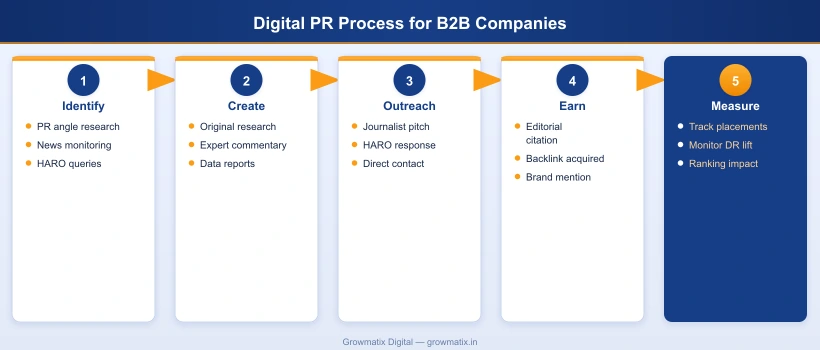
HARO and Journalist Outreach for B2B Companies
How to Use HARO Effectively as a B2B Brand
HARO (now operating through Connectively) sends daily journalist query digests across categories including business, technology, marketing, and finance. B2B companies that monitor these consistently find relevant opportunities to provide expert commentary that earns citations in publications ranging from small niche blogs to Forbes, Inc., and major trade publications.
The HARO outreach process that earns placements:
- Set up category alerts. Subscribe to the Business/Finance, Technology, and General digest categories most relevant to your B2B vertical. Configure email filters to surface queries from journalists at target publications first.
- Qualify the query quickly. HARO opportunities expire fast. Evaluate each query on three criteria: Is the journalist from a publication with SEO authority? Is the question within your genuine expertise? Can you provide a unique answer that goes beyond what a generic search would return?
- Write a concise, quotable response. Effective HARO responses are 150-250 words. Lead with the direct answer in the first sentence. Add one or two specific supporting details (a named metric, a real scenario from your work, a tool-specific insight). Close with a one-sentence bio for attribution: “Name, Title, Company, URL.”
- Respond within 2 hours. Journalists with deadlines move quickly. Responses submitted after 4 hours are rarely read. Build a system where your designated spokesperson reviews HARO queries at set times each morning.
- Follow up once on placed articles. When your response is used, confirm the article URL and check whether a backlink was included. If not, a polite, single follow-up email requesting attribution is appropriate and occasionally successful.
One practical note on HARO volume: submitting to every relevant query produces diminishing returns. Prioritizing three to five high-quality responses per week to publications with demonstrated SEO authority outperforms submitting twenty generic responses to low-traffic outlets.
Beyond HARO: Qwoted, Featured, and Direct Journalist Outreach
HARO is the most widely known journalist-source matching platform, but it is not the only one. B2B brands that limit their reactive PR outreach to HARO miss a significant portion of available journalist query volume:
- Qwoted: Focuses on financial services, business, and professional verticals. Journalists from Wall Street Journal, Bloomberg, and Financial Times actively use the platform for source queries. Ideal for B2B brands in finance, fintech, and enterprise technology.
- Featured.com: Aggregates expert contribution requests from online publications and content creators. Lower authority ceiling than HARO/Qwoted on average, but higher conversion rate because competition per query is lower.
- ProfNet (PRNewswire): A professional network used by journalists at major publications seeking expert sources. Higher barrier to entry (subscription required) but correspondingly higher quality of journalist queries.
- Direct journalist outreach: Building a proprietary list of journalists who cover your vertical and pitching them proactively with data, original research, or expert angles before they post queries. This requires investment in relationship development but produces the highest quality placements because you control the narrative framing.
Data-Led Content That Earns B2B Media Coverage
Original Research as a Digital PR Asset
Original research is the highest-ROI content investment for B2B digital PR. When your organization publishes proprietary data that no other source has, journalists covering your vertical have a specific reason to cite you: you have something they cannot get elsewhere. This positions your brand as a primary source rather than a commentary source, earning citations that persist across multiple news cycles as other content creators reference the same data.
According to Moz’s analysis of link earning content types, original research consistently outperforms other content formats for editorial link acquisition, particularly in B2B verticals where data-backed claims are the standard for credible journalism.
The anatomy of original research that earns B2B press coverage:
- Proprietary methodology: The data must come from a source only you have access to: your platform’s anonymized aggregate data, a survey you commissioned, or an analysis you performed on a publicly available dataset that no one else has published. Repackaging existing public statistics is not original research.
- Specific, counterclaim-worthy findings: Research earns citations when it confirms a hypothesis that journalists can reference, contradicts a commonly held belief, or quantifies a trend that practitioners knew anecdotally but could not cite. “Our analysis of 500 B2B SaaS sites found that pages with author bios rank 31% higher on average for informational queries than comparable pages without authorship” is citable. “B2B content performs better with E-E-A-T signals” is not.
- Annual cadence: A single research report earns one cycle of coverage. An annual report earns coverage every year while building a growing citation base as previous editions continue to be referenced. The compounding authority effect of annual research publication is significant over a 3-5 year horizon.
Benchmark Reports and Industry Data Studies
For B2B brands that do not have proprietary platform data, survey-based benchmark reports are the practical alternative. A well-designed industry survey of 200-500 professionals in your target vertical produces publishable, citable data with a 4-6 week execution timeline and a relatively modest budget for survey panel access.
Benchmark report formats that earn B2B media coverage:
- State of [Industry] reports: Annual surveys covering key challenges, technology adoption rates, budget allocation trends, and priority shifts in a specific vertical. These become go-to citation sources for journalists covering industry analysis pieces.
- Tool or channel benchmark data: Performance benchmarks for specific marketing channels (email open rates by B2B industry, paid search CPCs by vertical, organic CTR benchmarks by SERP position) are consistently referenced by practitioners and cited in tool comparison content.
- Decision-maker surveys: Surveys of C-suite or VP-level buyers on purchasing priorities, vendor evaluation criteria, or technology stack decisions have strong appeal for B2B trade publications whose readers are those same decision-makers.
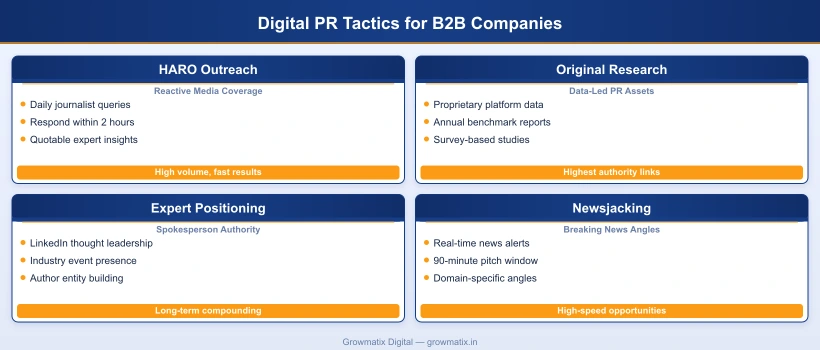
Expert Positioning for B2B Digital PR
Building a Spokesperson Strategy for B2B Brands
The most durable digital PR programs for B2B brands are built around named individuals, not corporate entities. Journalists prefer quoting named experts with verifiable credentials over anonymous company spokespeople. Google’s quality evaluation systems assign E-E-A-T signals to author entities, not to organizations. Both dynamics push toward the same investment: identifying and developing two to three named experts within your organization whose thought leadership consistently earns coverage.
A spokesperson strategy for B2B digital PR requires:
- Select the right spokespeople. Choose individuals with genuine subject matter expertise in the topics you want to earn coverage on, combined with the communication skills to translate that expertise into quotable, accessible insights. The most technically competent person on your team is not always the right media spokesperson.
- Build their external profiles. LinkedIn profiles with detailed professional history, published articles on LinkedIn or Medium, speaker profiles at industry events, and bylines on recognized publications all contribute to building the author entity that Google and journalists evaluate. A spokesperson with no external presence is harder to place than one with a verifiable track record.
- Create a response library. Develop 20-30 pre-drafted expert commentary snippets on the most common topics in your vertical. When journalist queries arrive, spokespeople can adapt these rather than writing from scratch, reducing response time from hours to minutes.
- Track coverage systematically. Use Google Alerts, Mention, or Ahrefs alerts to monitor when your spokespeople are cited. Verify that links are included, correct, and pointing to the intended destination. Document each placement for quarterly reporting.
Thought Leadership on LinkedIn and Industry Platforms
Journalists actively research sources before submitting HARO queries. A B2B expert with a strong LinkedIn presence who consistently publishes insights on their vertical is dramatically more likely to be contacted directly for expert commentary than one with no visible external presence. Thought leadership content on LinkedIn and relevant Slack communities (RevOps co-op, SaaStr, CMO Alliance) builds the pre-existing visibility that drives inbound journalist interest.
The LinkedIn content strategy that builds journalist-attractive expertise signals:
- Long-form LinkedIn articles on practitioner-level topics, not motivational or generic business content
- Data-led posts citing original observations from your work: what you measured, what surprised you, what you changed as a result
- Commentary on breaking industry news with a specific perspective, not just reaction: “Google’s March 2025 core update hit B2B service pages disproportionately in our portfolio. Here is what we observed across 14 clients and what we changed.”
- Regular engagement in comments on articles from journalists who cover your space, demonstrating expertise before a relationship becomes transactional
Newsjacking for B2B Companies
How to Identify Newsjacking Opportunities in B2B
Newsjacking is the practice of inserting your brand’s perspective into a breaking news story before the initial coverage cycle closes. For B2B companies, this requires a monitoring system that surfaces relevant news fast enough to pitch within the 2-4 hour window when journalists are actively sourcing expert commentary for follow-up pieces.
Effective B2B newsjacking monitoring setup:
- Google Alerts for primary keywords in your vertical (e.g., “B2B SaaS funding,” “Google algorithm update,” “enterprise software breach”) delivered in real-time, not daily digest
- Twitter/X lists following key journalists and industry analysts in your space for early signal on breaking stories before they enter mainstream coverage
- Feedly or Inoreader aggregating RSS feeds from 30-50 top publications in your vertical, reviewed twice daily
- Slack channels in relevant industry communities (SaaStr, RevOps Co-op, EcommerceFounder) where practitioners discuss breaking news before it becomes mainstream
The qualification question for any newsjacking opportunity: does your organization have a specific, differentiated perspective on this story that a journalist cannot get from a generic source? If the answer is yes, and your spokesperson can formulate a pitch within 90 minutes, the opportunity is worth pursuing.
Newsjacking Without Reputation Risk
Newsjacking carries a genuine reputational risk for B2B brands when executed poorly: inserting a commercial angle into a sensitive news story, overclaiming expertise on a topic outside your domain, or providing inaccurate commentary under time pressure. B2B brands serve sophisticated, skeptical professional audiences who notice and remember these missteps.
The rules that keep B2B newsjacking credibility-safe:
- Only comment within your verified expertise domain. A B2B SEO agency should not pitch cybersecurity commentary, even if a cybersecurity story is trending. The editorial connection must be genuine.
- Never speculate on facts not yet established. When news is breaking, information is incomplete. Only offer commentary on what you know with certainty, not on what you assume will be revealed. Incorrect speculation gets attributed to your brand permanently.
- Avoid commenting on stories with serious human impact. Layoffs, accidents, and crises should not be leveraged for brand commentary. The reputational cost of appearing opportunistic outweighs any coverage value.
- Verify before publishing your own take. If you are writing reactive content (a blog post or LinkedIn article responding to breaking news), confirm the facts from at least two primary sources before publishing. According to Search Engine Land’s digital PR guidelines, reactive content published with factual errors damages brand credibility far more than the original story provided coverage value.
Measuring Digital PR Impact on B2B SEO
Metrics That Matter for B2B Digital PR
Digital PR for B2B requires a measurement framework that connects earned coverage to business outcomes, not just media vanity metrics. The right metrics depend on your goal (domain authority building versus topical authority versus brand entity development) but the core reporting set for most B2B digital PR programs includes:
| Metric | What It Measures | Where to Track | Target Direction |
|---|---|---|---|
| Referring Domains (New) | Count of new unique domains linking to site per month | Ahrefs, Semrush | Consistent growth month-over-month |
| Domain Rating / Authority Score | Aggregate domain authority influenced by new links | Ahrefs DR, Semrush AS | Gradual upward trend (quarterly) |
| Editorial Placements | Count of editorial mentions (linked + unlinked) per month | Google Alerts, Mention, Ahrefs | Increasing placement rate |
| Target Keyword Rankings | Ranking movement on commercial keywords tied to PR investment | GSC, Ahrefs Rank Tracker | Position improvement on target pages |
| Brand Search Volume | Branded query impressions as a proxy for brand awareness | Google Search Console | Growing impressions on brand terms |
Using GSC and Ahrefs to Track PR-Driven Authority
Two tools provide the most useful signal for B2B digital PR measurement:
Google Search Console: Navigate to GSC > Links > External Links > Top linking sites to monitor new domains as they are indexed. Placements typically appear in GSC within 2-4 weeks of the article going live, depending on the publication’s crawl frequency. The GSC > Links > Top linked pages view shows whether new links are pointing to your intended destination pages or to the homepage by default.
Ahrefs: Use Ahrefs > Site Explorer > Referring Domains > New to see all new linking domains in the current period. Filter by DR 40+ to isolate high-authority placements from noise. The Ahrefs > Backlink checker > Anchors report shows what anchor text journalists use for citations, which informs which topics your brand is being recognized for by the external web.
For B2B brands executing digital PR alongside content publishing, a practical framework is to run a quarterly attribution analysis: match the timing of major PR placements (by publication date) against ranking changes in the 30-60 day window following each placement. This produces a directional ROI case for the program without requiring attribution precision that is not achievable in organic search.
When building a long-term off-page strategy, converting existing brand mentions to links is a complementary tactic to active digital PR. The practice of turning brand mentions into links can recover significant link equity from coverage that was already earned but never linked, without requiring new outreach.
According to Semrush’s analysis of digital PR effectiveness, combining active outreach with a systematic brand mention monitoring program produces the highest total link acquisition rate for B2B brands at equivalent investment levels.