



How to Build Topical Authority in a Competitive B2B Niche
Table of content
Topical authority has become the primary SEO differentiator for B2B brands that want to rank on competitive commercial keywords without relying solely on domain authority or backlink volume. The premise is straightforward: Google’s systems increasingly reward websites that demonstrate comprehensive, interconnected expertise on a subject over sites that produce isolated content with no thematic coherence. For B2B companies entering crowded verticals, topical authority is both the challenge and the clearest path forward.
This guide covers the operational mechanics of building topical authority in a competitive B2B niche: how to construct a topical coverage map, identify and close content gaps, structure clusters for maximum semantic density, and set realistic timelines for ranking movement. The strategies here are applicable to B2B SaaS, professional services, enterprise technology, and any vertical where decision-maker content competes with established category leaders.
What Is Topical Authority in B2B SEO?
Topical Authority vs. Domain Authority: Key Differences
Domain authority metrics (Ahrefs DR, Moz DA, Semrush AS) measure the aggregate strength of a site’s backlink profile. They are useful proxies for overall site credibility but are poor predictors of ranking performance on specific topic clusters. A site with a DR of 35 can consistently outrank a DR 65 competitor on a cluster of topically specific keywords if it has built deeper, more coherent coverage of that subject.
Topical authority operates differently. It is not a single metric but a system-level signal derived from the semantic completeness and interconnectedness of your content within a subject domain. According to Ahrefs’ analysis of topical authority, sites that cover a topic with greater semantic depth consistently outperform higher-DA competitors on long-tail and mid-funnel queries, particularly in B2B verticals where search volume is lower but purchase intent is high.
The practical implications for B2B SEO strategy:
- You do not need to outrank Forbes or a category giant across all topics. You need to build unambiguous authority within your specific niche sub-topic, which is achievable at any domain age.
- Content quality alone is insufficient. Isolated high-quality posts without topical coherence do not build authority clusters. The semantic connections between posts matter as much as individual post quality.
- Backlinks amplify topical authority but do not replace it. A well-structured topic cluster with modest link equity can outperform a poorly structured competitor site with stronger backlinks, especially on informational queries.
How Google Evaluates Subject Matter Expertise in B2B Niches
Google’s Helpful Content system and quality rater guidelines use E-E-A-T (Experience, Expertise, Authoritativeness, Trustworthiness) as the evaluative framework for content quality. For B2B websites, subject matter expertise signals include named author credentials, citations from recognized industry sources, depth of coverage within a topic cluster, and the presence of original data or practitioner-level insight that generic content cannot replicate.
Beyond E-E-A-T, Google’s systems evaluate topical authority through entity understanding and semantic coherence: does the content on your site form a semantically complete picture of your niche? Are posts interlinked in ways that reflect a coherent knowledge structure? Does your site appear in contexts where authoritative sources in your niche are discussed or cited? These signals collectively determine whether Google treats your site as a trusted source on a subject or as a peripheral contributor to a topic already better covered elsewhere.
For B2B companies, the clearest topical authority signal is comprehensive coverage of the buyer’s information journey: from awareness-stage educational content through consideration-stage comparison and evaluation content to decision-stage commercial pages. Sites that cover only the commercial layer without the informational cluster lack the topical depth that builds authority.
Topical Coverage Mapping for B2B Niches
How to Build a Topical Map from Primary Keywords
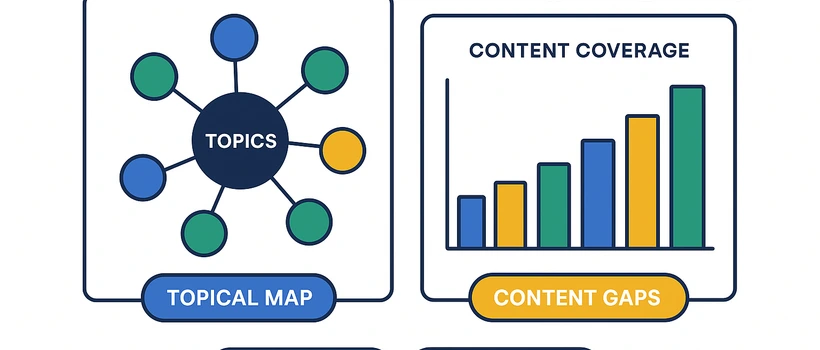
A topical map is a structured inventory of every sub-topic, question, and semantic variant associated with your core B2B niche, organized by search intent and content type. Building one before writing a single piece of content is the difference between systematic topical authority development and ad hoc content that never clusters into a coherent authority signal.
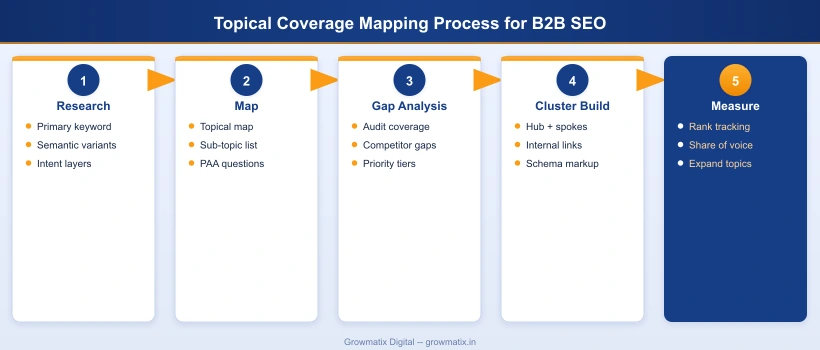
The topical map construction process:
- Start with your primary commercial keyword. This is the term most closely tied to your B2B product or service: “enterprise HR software,” “B2B demand generation agency,” “SaaS customer success platform.” This becomes the hub of your topical map.
- Extract semantic variants and related terms. Use Ahrefs > Keywords Explorer > Matching Terms and Also Rank For to surface the full keyword universe around your primary term. Export all keywords above a minimum monthly volume threshold (typically 50 to 100 for B2B) and group them by semantic similarity.
- Identify intent layers. Classify keywords by intent: informational (what is, how to, why), navigational (brand comparisons, platform names), commercial investigation (best X for Y, X vs Z, X alternatives), and transactional (hire, pricing, demo). Each intent layer maps to a specific content type in your cluster.
- Map PAA questions to spoke content. Use Google > People Also Ask and AlsoAsked to surface the specific questions buyers research before making decisions. Each distinct PAA question cluster is a potential spoke post assignment.
- Document coverage status. For each sub-topic identified, record whether your site currently has content that covers it, whether a competitor’s content dominates the SERP, and the priority level for new content creation based on traffic potential and competitive gap.
Content Gap Analysis: Finding Missing Coverage in Your Niche
Content gap analysis for topical authority is distinct from standard keyword gap analysis. Rather than comparing your keyword rankings against competitors, you are identifying the sub-topics within your niche that your site does not cover at all, which creates semantic holes in your topical map that prevent Google from treating your site as a comprehensive authority.
Three content gap types that most frequently limit B2B topical authority:
- Intent layer gaps: A site that covers only commercial pages with no supporting informational cluster. Service pages on their own, without how-to guides, comparison content, and definitional posts, do not have the topical context for Google to understand what expertise the site represents.
- Sub-niche gaps: Major sub-topics within your niche that you have zero content on. In a B2B SEO context, publishing only on-page SEO content with no coverage of technical SEO, link building, or content strategy creates a partial topical map that signals incomplete expertise.
- Question cluster gaps: Specific buyer questions that appear consistently in search (PAA, related searches, Reddit/Quora threads) that your content does not address. These are the highest-conversion content opportunities because they intercept buyers at the moment of active research.
A practical tool for systematic gap identification: run a Semrush > Keyword Gap analysis comparing your domain against three to five established competitors in your niche. Filter to keywords where competitors rank in positions 1 to 10 and your site does not appear in the top 30. This surfaces the specific informational sub-topics your topical map is missing relative to sites that already have established authority.
According to Semrush’s research on topical authority building, sites that close identified content gaps systematically rather than publishing content based on individual keyword volumes show stronger topical authority signals and more consistent ranking improvements over a 6-month horizon.
Content Cluster Strategy for B2B Topical Authority
Hub-and-Spoke Architecture for B2B Topic Clusters
The hub-and-spoke content model is the structural foundation of topical authority building. A hub post provides comprehensive coverage of a core topic at a strategic level, while spoke posts address specific sub-topics, use cases, and questions within that subject with greater depth than the hub can accommodate. The internal linking between hub and spokes creates the semantic network that signals topical authority to search engines.
Effective hub-and-spoke architecture for B2B requires:
- Hub posts that are genuinely comprehensive. A hub post targeting “B2B content marketing” should cover strategy, execution, measurement, tools, and industry-specific considerations at a depth that establishes it as the definitive resource on the topic. Shallow hub posts that just link to spokes without providing standalone value do not anchor topical authority effectively.
- Spokes that go deeper, not wider. Each spoke post should be more specific than its hub, not just a variation on the same content. A spoke on “B2B content distribution for enterprise sales cycles” provides depth on a specific sub-topic rather than restating the hub’s overview at a different length.
- Bidirectional internal links between hub and spokes. Every spoke must link back to the hub, and the hub must link to each relevant spoke. This bidirectional linking creates the internal PageRank flow that reinforces the hub’s position as the authoritative anchor of the cluster.
For B2B companies implementing their first cluster, a well-executed topic cluster strategy typically consists of one hub post and 6 to 10 spoke posts covering distinct informational sub-topics, connected through natural inline internal links. The cluster should be published in a planned sequence rather than all at once, allowing each piece to index and accumulate signals before the next is added.
Prioritizing Spoke Posts by Search Demand and Competitive Gap
Not all gaps in a topical map are equal priority for content creation. Sequencing spoke post production based on combined search demand and competitive gap gives B2B content teams the fastest path to early ranking wins while building toward comprehensive cluster coverage.
| Priority Tier | Search Demand | Competitive Gap | Publish Sequence |
|---|---|---|---|
| Tier 1: Quick wins | Moderate (100-500/mo) | Large: competitors rank 11-30 or miss intent | Weeks 1-4 |
| Tier 2: Cluster anchors | High (500-2,000/mo) | Moderate: top 10 dominated by high-DA sites | Weeks 5-12 |
| Tier 3: Authority builders | Low (under 100/mo) | Small: niche sub-topics with minimal coverage | Ongoing cadence |
| Tier 4: Hub post | High, competitive | Competitive: requires cluster to rank | After cluster is 50% complete |
Publishing spoke content before the hub is a deliberate sequencing choice: spoke posts on lower-competition sub-topics accumulate early traffic and internal link equity that subsequently flows to the hub when it is published. Launching a hub post on a high-competition keyword before its supporting cluster exists means it ranks in a topical vacuum with no cluster authority to amplify it.
Competing Against Established B2B Authorities
How to Enter a Competitive Niche Without Domain History
The most consistent strategy for new B2B sites entering competitive niches is hyper-niche topical dominance: choose a sub-segment of the target niche narrow enough to achieve near-complete topical coverage quickly, rank comprehensively within that sub-segment, then expand laterally. Rather than trying to compete with an established enterprise software blog across all of “B2B SaaS marketing,” a new entrant might achieve full topical authority on “B2B SaaS pricing page optimization” within 6 months, then expand to adjacent topics from a position of established authority.
The specific tactics that accelerate authority building in a competitive niche:
- Original data and research. Publishing proprietary findings, benchmark data, or analysis that established competitors have not produced gives your content a citation reason that generic overview content cannot match. Journalists and other sites linking to original data create the external authority signals that compound over time.
- Expert author positioning. Bylined content from named, credentialed practitioners builds E-E-A-T signals faster than anonymous or company-attributed content. A named VP of Marketing at a B2B SaaS company writing about pipeline generation has inherent credibility that a generic “content team” byline does not.
- Deep coverage of underserved intent layers. Most established B2B sites in competitive niches are strong on commercial content and weak on mid-funnel informational content. Identifying and publishing comprehensively on the specific buyer questions that sit between awareness and purchase creates a topical authority foothold where competition is thinner.
Niche Authority Signals That Accelerate Topical Coverage
Beyond content volume and structure, specific on-site and off-site signals accelerate how quickly Google recognises topical authority in a B2B niche. These signals work in combination: no single factor builds authority in isolation, but the presence of multiple signals creates a compounding recognition effect.
For off-page authority building alongside topical content development, a structured B2B authority building guide covers how to acquire topically relevant backlinks that reinforce, rather than contradict, your chosen niche focus. Backlinks from topically adjacent sites carry more relevance signal than generic high-DA links from unrelated domains.
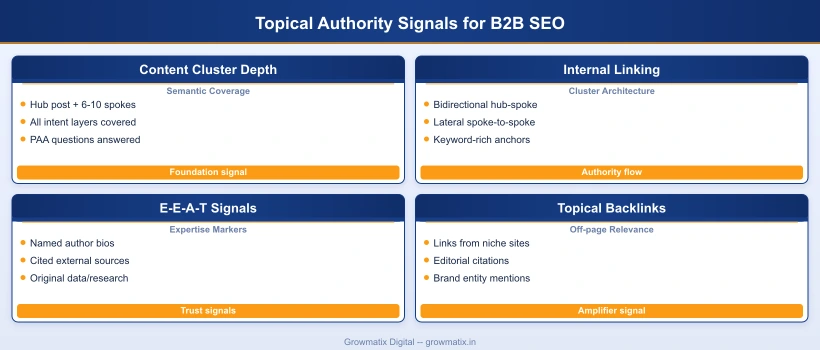
- Schema markup on all cluster content. Article, FAQPage, HowTo, and BreadcrumbList schemas implemented consistently across a cluster help Google’s systems understand the content type, topic, and structure of each post in relation to the cluster as a whole.
- Topically relevant backlinks. Links from other sites that cover the same subject domain carry more topical authority signal than general DR-boosting links from unrelated verticals. A B2B fintech site linked to by CFO.com and AccountingToday builds fintech topical authority faster than the same number of links from general marketing blogs.
- Consistent author entity signals. Named authors with verifiable external presence (LinkedIn, speaking engagements, published bylines in trade press) strengthen the E-E-A-T signals across all content published under their name. This is particularly important in YMYL-adjacent B2B niches (legal tech, fintech, healthtech) where Google applies stricter quality evaluation.
- FAQ and structured answer content. Content that directly answers the specific questions buyers ask (formatted as FAQ schemas, structured H3 sub-sections, or definitional callouts) is more likely to surface in AI Overviews, featured snippets, and PAA results, generating visibility signals that reinforce topical authority recognition.
How Long Does It Take to Build Topical Authority in B2B?
Timeline Benchmarks for B2B Topic Clusters
Realistic timeline expectations prevent two failure modes that are common in B2B content programs: abandoning a cluster before it has enough content to register as authoritative, and over-investing in content production without the internal linking and schema infrastructure needed to activate the cluster’s authority signals.
Indicative timelines based on niche competitiveness and publication cadence:
- Months 1-3: Spoke posts in Tiers 1 and 3 are published and indexed. Initial rankings appear on long-tail and low-competition informational queries. No significant movement on commercial or high-competition terms yet.
- Months 3-6: Hub post published with full cluster of 6 to 10 spokes. Internal linking is fully implemented. Cluster-level topical signals begin to consolidate. Rankings on mid-competition informational terms improve. First movements on commercial adjacent keywords.
- Months 6-12: Consistent organic traffic growth across the cluster. The hub post begins to compete on its primary commercial keyword. New backlinks earned by spoke content flow equity to the hub. Topical authority in the sub-niche is established.
- Months 12-18: In competitive B2B niches, this is when cluster authority reaches a threshold where commercial keyword rankings become stable and compounding rather than volatile. Expansion to adjacent sub-topics at this stage leverages existing cluster authority rather than building from zero.
According to Moz’s research on SEO timelines, most competitive B2B keywords require 6 to 12 months of consistent content and link acquisition activity before ranking movements stabilise, with topical authority development aligning closely with this window when cluster content is structured correctly.
Accelerating Authority with Internal Linking and Schema
Two on-site factors consistently accelerate topical authority recognition faster than content volume alone: a structured internal linking architecture and consistent JSON-LD schema implementation across the cluster.
For internal linking, the key is precision over volume. Every spoke post should link to the hub post exactly once, using a keyword-rich anchor that reflects the hub’s primary target keyword. The hub should link to each spoke using anchors that reflect the spoke’s specific sub-topic. Linking spokes to each other creates lateral semantic connections that strengthen the cluster’s topical coherence beyond the simple hub-and-spoke model. Use Screaming Frog > Internal > All Inlinks to audit that every cluster post has the correct bidirectional links in place after publication.
For schema, implement consistent Article schema across all cluster posts, FAQPage schema on any post with FAQ sections, and HowTo schema on step-by-step content. Validate with Google > Rich Results Test after each publication to confirm schema is processed without errors. Schema implementation does not directly boost rankings but provides structured entity signals that help Google’s systems classify and contextualise content within a topic domain, accelerating the entity recognition process that underlies topical authority.
Measuring Topical Authority Growth in B2B SEO
Metrics That Reflect Topical Coverage Progress
Topical authority does not have a single dashboard metric. Progress is tracked through a combination of ranking movement across the cluster, organic traffic growth on informational queries, and share-of-voice improvements on the target topic within your niche.
| Metric | What It Signals | Where to Track | Review Cadence |
|---|---|---|---|
| Cluster keyword rankings | Position movement across hub and all spoke keywords | Ahrefs Rank Tracker, GSC Performance | Weekly |
| Topical share of voice | % of clicks from cluster keywords your site captures vs. competitors | Semrush Position Tracking | Monthly |
| Indexed pages per cluster | Confirmation all cluster posts are indexed and crawled | GSC Coverage, Ahrefs Site Audit | After each publish |
| Internal links per cluster post | Completeness of hub-spoke linking architecture | Screaming Frog, Ahrefs Links | Monthly audit |
| Featured snippet and PAA wins | Topical recognition by Google for specific questions | Semrush SERP Features, Ahrefs | Monthly |
Tools and Reports for Tracking Authority by Topic
The most actionable reporting setup for B2B topical authority tracking combines three tools covering different signal layers:
Google Search Console: Navigate to GSC > Performance > Search results and filter by a topic-level query (e.g., “topical authority”) to see all impressions, clicks, and position data across every keyword variation where your cluster content appears. The GSC > Performance > Pages filter shows which cluster posts are generating the most traffic, identifying which spokes are performing and which need strengthening.
Ahrefs: Use Ahrefs > Site Explorer > Organic Keywords filtered by a topic keyword seed to extract the full ranking distribution across your cluster. The Ahrefs > Content Gap tool run quarterly identifies new sub-topics that competitors have published on since your last gap analysis, flagging emerging coverage requirements before they affect your authority ranking.
Semrush Position Tracking: Set up a campaign tracking your 30 to 50 target cluster keywords and monitor the Semrush > Position Tracking > Overview > Visibility metric as a proxy for overall cluster share of voice. A sustained upward trend in visibility on your cluster keyword set over a 6-month window is the clearest indicator that your topical authority strategy is producing measurable results.
According to Search Engine Land’s coverage of topical SEO in 2025, brands that combine systematic gap analysis with structured cluster publishing and consistent measurement show the most predictable authority growth outcomes, particularly in B2B verticals where content quality and semantic completeness matter more than raw publication volume.