




Long-form vs Short-form Content: What B2B SEO Data Shows in 2026
Table of content
The debate over content length in B2B SEO has produced more confusion than clarity. Content teams face conflicting signals: some tools push word count targets, some studies cite 7,000-word posts as the gold standard, and Google itself says word count is not a ranking factor. All of these statements can be true simultaneously, which is why the debate does not resolve cleanly.
The data does not say “long is better” or “short is better.” It says match matters: the content that ranks is the content that most completely satisfies the intent behind the query, regardless of how many words that takes. For some B2B queries, that means 4,000 words. For others, it means 600. The failure mode in most B2B content programs is not length itself but applying a uniform length target to queries that require different formats.
This post examines what the research from Ahrefs, Semrush, and HubSpot actually shows about B2B content length and SEO performance, when long-form and short-form each win, and how AI Overviews are changing the equation in 2026. If your team is working from a B2B content SEO playbook, the length decisions here connect directly to your keyword-to-format mapping process.
Does Content Length Directly Affect B2B SEO Rankings
The direct answer: no, word count is not a ranking signal. The more useful answer: content length correlates with ranking factors that Google does use, which is why the correlation appears in nearly every large-scale content study.
What Google Has Officially Said About Word Count
Google’s position on content length has been stated consistently across multiple public communications. The Google Search Central helpful content documentation is unambiguous: content should be written for people with sufficient depth to genuinely help the reader, not to meet an arbitrary length requirement. Google representatives have stated repeatedly in public Q&As that word count itself is not a metric Google uses to evaluate content quality.
The practical implication: padding content to hit a 2,500-word target with redundant restatements, thin filler sections, or irrelevant tangents does not improve ranking eligibility. Conversely, a precisely structured 800-word piece that fully answers the query can outrank a 3,000-word piece that covers the same ground inefficiently.
What Correlation Data Shows From Ahrefs and Semrush
The correlation between long-form content and strong rankings is real, but it is not causal. Ahrefs research on long-form content performance consistently shows that longer pages earn more referring domains on average, with pages over 3,000 words generating substantially more backlinks across most content categories than pages under 1,000 words.
Semrush’s annual State of Content Marketing reports document similar patterns. Long-form content (posts over 3,000 words) drives more organic traffic and earns more inbound links than shorter formats in aggregate. The Semrush data includes a critical nuance: the performance advantage of long-form content is strongest for informational queries and weakest for high-intent transactional queries, where structured short-form content performs on par or better.
Why Long Content Correlates Without Causing Rankings
The mechanism explains the correlation. Long-form content tends to outperform because it covers more semantic subtopics, satisfying the breadth of intent behind complex informational queries. Comprehensive content earns more backlinks because other publishers reference it as a complete source. Longer guides naturally include more keyword variants and related terms, increasing semantic coverage.
None of these factors are word count itself. They are depth, comprehensiveness, and topical coverage. A 4,000-word post that achieves all of these naturally will outperform a 1,000-word post that does not, but so will a 1,500-word post structured around the same depth, if the query permits it. The working principle: write to the depth the query requires, not to a word count target.
When Long-form Content Wins for B2B SEO
Long-form content has a clear competitive advantage for specific query types, and identifying those types accurately is more valuable than any general “longer is better” rule.
Competitive Informational Queries at the Top of the Funnel
For high-competition informational queries at the top of the B2B funnel, long-form content is typically the entry requirement, not a differentiator. When the top five ranking pages for a keyword all exceed 2,000 words, a shorter page has a structural disadvantage in topical coverage that is difficult to overcome. The SERP is signaling that searchers on this query need comprehensive treatment, and Google has validated that comprehensive treatment by ranking it repeatedly.
Pillar pages and topic cluster hubs represent the clearest application of this principle. A pillar page for a competitive cluster like “B2B content marketing” or “enterprise SEO strategy” needs to function as the authoritative reference point for the topic, covering subtopics, linking to spoke pages, and signaling sufficient depth to justify its role as the hub. Building this architecture effectively requires a considered topic cluster content strategy before deciding on length targets.
Backlink Acquisition With Long-form B2B Content
The backlink advantage of long-form content is the most consistently documented finding across major content studies. Backlinko’s analysis of over 900 million blog posts found that long-form content earned significantly more referring domains than short-form content across all content categories studied. For B2B brands where link acquisition is a limiting factor, producing comprehensive reference-quality content at 3,000 to 5,000 words serves a dual function: it targets informational rankings and generates link equity that benefits the broader domain.
The content types that earn backlinks most effectively in B2B tend to be original research with proprietary data, comprehensive guides cited by other publications, statistical roundups that aggregate industry data, and detailed how-to content that practitioners share with colleagues. All of these formats reward length as a by-product of the comprehensiveness that makes them linkable, not length itself.
Semantic Completeness in Topic Cluster Spoke Pages
Within a topic cluster, spoke pages also benefit from sufficient depth, though less so than hub pages. A spoke page targeting a specific subtopic needs enough semantic coverage to signal that it is the authoritative resource on that subtopic, not just a thin variation of the hub page. This typically means 1,500 to 2,500 words for competitive informational spokes, with comprehensive H2 and H3 coverage of the questions a B2B content manager would actually ask on the specific subtopic.
| Long-form Content Advantage | Best Query Types | Typical Length |
|---|---|---|
| Topical authority and depth | Complex informational queries (how, why, what is) | 2,500 to 5,000+ words |
| Backlink acquisition | Reference guides, research roundups, statistical compilations | 3,000 to 5,000+ words |
| Topic cluster hub pages | Pillar keywords with broad informational intent | 3,500 to 5,000 words |
| Competitive SERP displacement | Keywords where top five results all exceed 2,000 words | Match and exceed competitor depth |
When Short-form Content Outperforms in B2B SEO
Short-form content is frequently underestimated in B2B SEO strategy. Several high-value query categories favor concise, structured content over comprehensive long-form treatment, and treating every piece as a long-form opportunity is a common content planning mistake.
High-Intent Transactional Queries in B2B
When a B2B buyer searches for a specific tool comparison, pricing page, or vendor shortlist query, they have a defined intent: they want an answer, not an education. A query like “Salesforce vs HubSpot for mid-market B2B” does not require a 4,000-word guide. It requires a clear, structured comparison that addresses the key decision criteria efficiently. Long-form content on high-intent queries can actively hurt conversion by making the buyer search for the answer within an unnecessarily comprehensive page.
The pattern holds across bottom-of-funnel B2B content: trial sign-up pages, demo request landing pages, pricing comparison content, and use-case-specific landing pages all perform better at 800 to 1,500 words than at 3,000-word lengths that dilute the conversion path. For these pages, clarity and structure matter more than coverage.
FAQ and Definition Content for AI Overview Eligibility
FAQ pages and definition-style content are among the highest-performing short-form formats for B2B SEO in 2026, driven specifically by their AI Overview citation eligibility. Google AI Overviews select content that directly answers a specific question with minimal processing. A focused 600-word FAQ page that clearly defines five industry terms can generate more AI-referred traffic than a comprehensive 4,000-word guide that covers the same terms embedded within broader discussions.
The format rule for definition and FAQ content targeting AI Overviews: the answer must appear in the first two to three sentences of the section, without extended contextual framing. AI extraction systems retrieve opening sentences preferentially. Content that buries the answer in paragraph three, regardless of how accurate or comprehensive that answer is, performs worse in AI citation than content structured with the answer first.
Freshness-Driven Update Posts and Trend Coverage
B2B trend coverage, algorithm update analysis, and news-driven content performs best as concise, high-freshness short-form posts rather than comprehensive long-form treatments. A 400-word post published within 24 hours of a major platform update, structured to capture the key question searchers will type in response to the news, can rank quickly for freshness-dependent queries before longer content can be produced and indexed.
This freshness advantage is particularly important for AI citation eligibility on time-sensitive queries. Perplexity’s retrieval system weights recency significantly for competitive informational queries, and a concise, accurate recent post will frequently outperform a comprehensive older guide for queries with a freshness component.
Content Length and AI Overviews in 2026
The rise of AI Overview coverage across Google search results has introduced a new dimension to content length decisions that most B2B content teams have not yet accounted for. The key insight: AI Overviews and organic rankings use related but not identical evaluation criteria, and content structure matters more than total word count for AI citation eligibility.
How AI Overview Selection Differs From Organic Ranking
Organic rankings evaluate the page as a unit: domain authority, on-page optimization, topical relevance, and page experience all contribute to where the page ranks. AI Overviews evaluate content at the section level: the system identifies passages within pages that directly answer the query, and those passages are synthesized into the generated summary.
The practical consequence: a page can rank position one for a keyword while contributing zero content to the AI Overview for that keyword, if the page’s section structure does not produce extractable answer passages. Conversely, a page ranking position six can supply content to an AI Overview if its section architecture is optimized for passage-level extraction. Semrush’s analysis of AI Overview citation patterns found that content from top-ranking pages is not always cited in AI Overviews, reinforcing that ranking position and AI citation eligibility are distinct outcomes requiring distinct optimization approaches.
Passage-Level Retrieval and the Section Length Equation
Research on AI citation factors across large-scale domain studies found that section length between headings is a meaningful predictor of AI citation rates. Sections of 120 to 180 words between H2 and H3 headings correlate with higher AI citation frequency than shorter sections (under 50 words, which lack sufficient context) or longer sections (over 300 words, where the key answer becomes harder for AI systems to isolate and extract).
This creates a structural recommendation for B2B content teams: longer content should have more sections, not longer sections. A 3,000-word post with fifteen focused sections of 120 to 180 words outperforms a 3,000-word post with five dense sections of 600 words for AI citation purposes, even when the organic ranking performance is similar. The distribution of length across well-structured sections matters more than total word count for AI Overview eligibility.
Optimal Section Architecture for AI Citation
Building content that performs for both organic rankings and AI citations requires a specific structural approach that does not conflict with writing long-form content:
- Answer-first structure in every section: The direct answer to the question implied by the H2 or H3 heading should appear in the first one to two sentences, before elaboration or supporting context.
- Self-contained paragraphs: Each paragraph should make sense and provide value when read in isolation. AI retrieval systems extract passages independently, not in the context of surrounding paragraphs.
- Data attribution within the passage: Specific data points with source attribution, included within the passage rather than linked to footnotes, correlate with higher AI citation rates across multiple platforms.
- Avoid extended introductory framing: Section openings that spend two or three sentences providing background before stating the answer reduce citation eligibility, regardless of how thorough the eventual answer is.
B2B Content Length by Type and Funnel Stage
The most useful application of content length research is not a single benchmark number but a segmented framework that maps content formats to appropriate length targets based on function and funnel stage.
Top-of-Funnel Educational Content
Top-of-funnel B2B content, including category education, problem-awareness pieces, and industry trend analysis, targets buyers who are not yet actively evaluating solutions. The primary objectives at this stage are organic reach, backlink acquisition, and brand introduction.
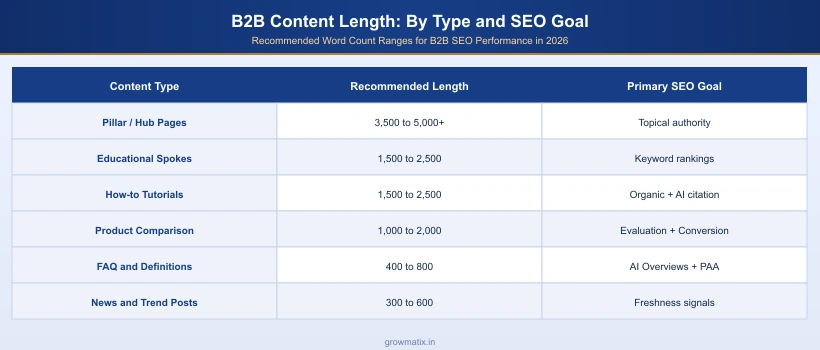
Long-form performs best at the top of the funnel for competitive informational keywords. Pillar pages and comprehensive guides at 3,500 to 5,000 words serve as the anchor for topic cluster architecture and generate the most link equity over time. Spoke pages and supporting educational posts perform well between 1,500 and 2,500 words when targeting specific informational subtopics. Thought leadership content, where the goal is perspective and brand authority rather than keyword ranking, performs well at 800 to 1,500 words and supports a higher publication frequency than comprehensive guides.
Mid-Funnel Evaluation and Comparison Content
Mid-funnel B2B content targets buyers who are actively researching solutions and evaluating vendors. Queries at this stage include category comparisons, feature matrices, integration guides, and use-case-specific content. The buyer intent is more defined, and content that efficiently addresses evaluation criteria outperforms comprehensive education at this stage.
Product comparison content and vendor evaluation guides perform well between 1,000 and 2,000 words, structured around comparison tables, clear feature breakdowns, and decision criteria sections. How-to tutorials and implementation guides that demonstrate product capability work well at 1,500 to 2,500 words, particularly when they include specific numbered steps that demonstrate practical knowledge. These formats also perform well in AI Overviews when structured with clear section headers and step-by-step organization.
Bottom-of-Funnel Decision Content
Bottom-of-funnel B2B content targets buyers who are close to a purchase decision. These pages need to resolve final objections and facilitate conversion, not provide comprehensive education. Page length here is determined by conversion optimization requirements, not content depth targets.
Case studies and success stories perform best at 800 to 1,200 words, structured around the buyer’s situation, the problem, the solution, and quantified results. Pricing and ROI content works well at 600 to 1,000 words, with clear structure and specific numbers. Demo and trial request pages perform best at 300 to 600 words with strong CTA hierarchy and minimal friction. Long content at the bottom of the funnel introduces distraction rather than building confidence.
| Content Type | Funnel Stage | Recommended Length | Primary Goal |
|---|---|---|---|
| Pillar / Hub pages | ToFu | 3,500 to 5,000+ words | Topical authority + Organic traffic |
| Educational spoke posts | ToFu | 1,500 to 2,500 words | Keyword rankings + Cluster depth |
| Thought leadership | ToFu / MoFu | 800 to 1,500 words | Brand authority + Backlinks |
| How-to tutorials | MoFu | 1,500 to 2,500 words | Organic traffic + AI citation |
| Product comparison | MoFu | 1,000 to 2,000 words | Evaluation support + Conversion |
| FAQ and definition content | ToFu / MoFu | 400 to 800 words | AI Overviews + PAA |
| Case studies | BoFu | 800 to 1,200 words | Trust building + Conversion |
| News and trend posts | ToFu | 300 to 600 words | Freshness signals + Topicality |
How to Calibrate Your B2B Content Length Strategy
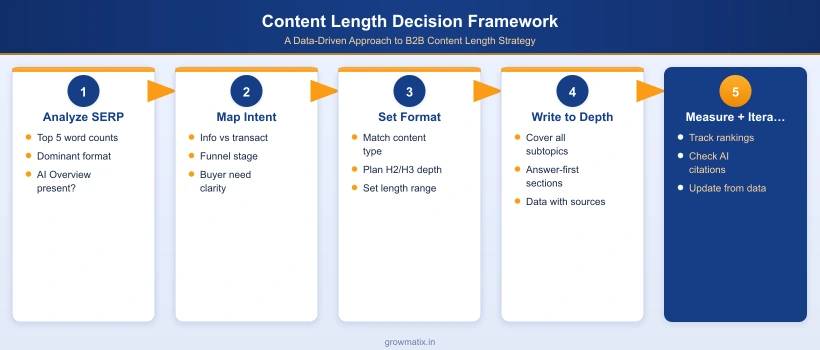
The content length decision should be an analytical process, not a judgment call. Here is a repeatable framework for determining the right length for any B2B content project, grounded in SERP data rather than industry averages.
Analyzing SERP Competition for Your Target Keywords
Before setting a word count target for any piece, analyze the SERP for the target keyword:
- Identify the top five organic results for your target keyword and record the approximate word count of each using a tool like Ahrefs Content Explorer, Semrush Writing Assistant, or a manual word counter on each page.
- Calculate the average word count across the top five results. This average is your baseline minimum for topical coverage and represents what Google has already validated as sufficient depth for this query.
- Identify the dominant content format (guides, listicles, comparison tables, definitions). The dominant format signals what the query intent is, and format should be matched before adjusting length.
- Check whether an AI Overview appears for the query. If yes, examine which content is cited and how it is structured. AI Overview citations can inform your section architecture more than total word count does.
- Assess the coverage gap between the top-ranking content and what you can produce. Can you genuinely add depth, different data, or a fresh angle? If the top result is already comprehensive and accurate, adding 500 words without adding coverage does not create a ranking advantage.
Measuring Content Length vs. Performance in Your Own Archive
Your own content archive contains the most directly applicable data for length calibration. A systematic audit of existing content reveals which length ranges perform best for your specific domain, audience, and content categories. Pull your top 20 organic traffic pages, record their word count and average ranking position, and segment by content type. This analysis consistently reveals length patterns specific to your domain that generic industry benchmarks cannot predict.
Google Search Console performance data combined with Ahrefs or Semrush content performance tools can identify which length ranges correlate with which ranking positions in your specific competitive context. Domain-specific data will always be more predictive than industry-wide averages when making length decisions for your content program.
Matching Length to Query Intent, Not Word Count Targets
Once you have SERP data and your own archive data, the length decision becomes a function of intent mapping rather than a default setting:
- Informational intent with multiple competing questions: needs sufficient length to answer all relevant subtopics (typically 2,000 to 4,000 words for competitive B2B keywords)
- Navigational or brand intent: concise and structured wins over comprehensive (typically 600 to 1,200 words)
- Transactional intent: conversion-focused structure at the shortest length that builds sufficient confidence (typically 500 to 1,500 words)
- Comparison intent: structured comparison format with sufficient coverage of each option (typically 1,000 to 2,000 words)
B2B content teams working on search-driven growth programs benefit from establishing explicit length guidelines by content type, rather than defaulting to uniform word count targets across all formats. The HubSpot research on optimal blog post length for organic search identifies the 2,100 to 2,400 word range as performing best for general informational queries, but B2B content teams should validate this benchmark against their own archive data before applying it uniformly. Audience, domain authority, and competitive landscape all affect the optimal length for a given domain.