



B2B Link Building: The Complete Authority-Building Guide for 2026
Table of content
B2B link building is the most consistently underexecuted component of enterprise SEO programs. Content production gets budget. Technical audits get scheduled. Link acquisition gets deprioritized because it is harder to systematize, slower to produce measurable results, and harder to attribute to a single team’s output. The predictable result: B2B websites with technically sound pages and well-structured content that still cannot break onto page one for their primary commercial keywords, because the referring domain count that Google requires to rank competitively never gets built.
The 2026 search environment makes this gap more consequential, not less. Google’s 2024 and 2025 core updates continued to compound domain-level authority as a ranking input alongside content quality and relevance. For competitive B2B keywords, the correlation between referring domain diversity and page one presence has strengthened, not weakened, despite broader changes to how Google evaluates helpful content. Building a strong B2B technical SEO foundation is the necessary prerequisite, but for most B2B sites with competent on-page structure already in place, link acquisition is the primary remaining growth lever.
This guide covers every major B2B link building strategy relevant for 2026, how to evaluate backlink quality, how to build a repeatable outreach system, and how to measure program performance. It is written for marketing directors and SEO leads at B2B companies who want a clear, executable framework rather than a list of generic tactics.
What Is B2B Link Building
B2B link building is the practice of earning hyperlinks from external websites to a B2B brand’s domain. Each backlink from a credible, topically relevant source functions as an editorial endorsement in Google’s evaluation model: a signal that another publisher found the linked content valuable enough to reference. The accumulation of these signals across a diverse set of authoritative referring domains increases a domain’s authority score, which correlates with the ability to rank for competitive, high-intent keywords.
How Google Uses Backlinks to Rank B2B Pages
Google has used hyperlinks as a ranking signal since the original PageRank algorithm. The mechanism has evolved significantly, but the core principle persists: links from high-authority, editorially independent sources pass more trust than links from low-quality, programmatically generated sources. Google’s spam policies documentation explicitly distinguishes between links that are “editorially placed or vouched for by the site’s owner” and links that are placed to manipulate PageRank.
For B2B pages competing on commercial keywords, the practical implication is that domain-level authority built through editorial links from relevant industry publications, analyst sites, and trade media consistently outperforms any volume of low-quality directory or forum links. Google evaluates both the authority of the linking domain and the topical relevance of the context in which the link appears.
Why B2B Link Building Works Differently Than B2C
The fundamental difference is publishing ecosystem density. Consumer brands can target thousands of general interest blogs, lifestyle publishers, and mass-media sites. B2B brands operate in vertical publishing ecosystems with far fewer authoritative outlets: 20 to 60 relevant trade publications, analyst firms, and industry blogs typically account for the majority of high-value link opportunities in any given sector.
This means B2B link building requires relationship cultivation at a level that B2C campaigns rarely need. The same editor at a SaaS industry publication may be the right target for three or four different link opportunities over two years. Building that relationship through consistent value delivery, whether through original data, expert commentary, or well-sourced guest contributions, compounds in ways that high-volume, low-personalization outreach never does.
B2B vs. B2C Link Building: Key Differences
Understanding where B2B link acquisition diverges from general link building prevents teams from applying consumer SEO tactics to an environment where they underperform.
| Dimension | B2B Link Building | B2C Link Building |
|---|---|---|
| Target publisher pool | 20-60 high-authority vertical publications per niche | Thousands of general-interest, lifestyle, and consumer media sites |
| Best-performing content type | Original research, benchmark reports, technical guides, comparison tools | Viral content, infographics, listicles, trend-driven stories |
| Outreach personalization | High: relationship-based, editor-specific pitches | Moderate: scalable templates with light personalization |
| Relationship duration | Long-term: same 20 editors over 2+ years | Transactional: one-off link placements more common |
| Typical link velocity | Slower: 3-10 high-quality links per month | Faster: campaigns can earn 50+ links from viral content |
| Primary outreach hook | Proprietary data, expert insight, product comparisons | Entertainment, utility, trending news angles |
| Co-marketing leverage | High: partner ecosystems create natural co-citation opportunities | Limited: fewer structured partnership link channels |
B2B Link Building Strategies That Work in 2026
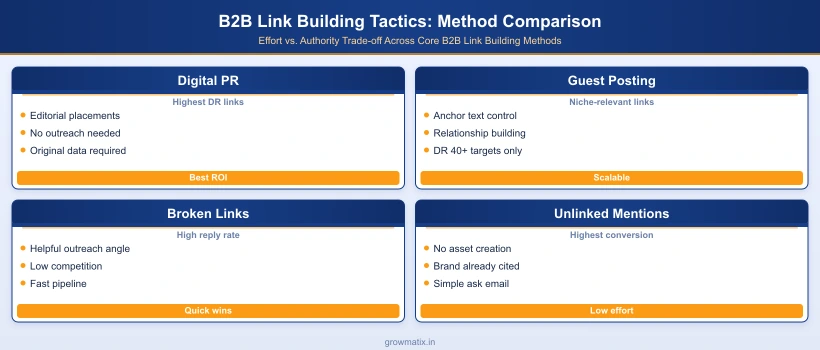
Effective B2B link acquisition in 2026 requires a portfolio approach. No single tactic produces enough volume or diversity to build competitive referring domain counts at the pace competitive keywords require. The strategies below are ordered from highest authority-per-link potential to highest scalability.
Digital PR for B2B Link Building
Digital PR generates editorial links from journalists, analysts, and industry bloggers by supplying them with citable data, newsworthy findings, or authoritative commentary that supports their own content. It consistently produces the highest Domain Rating links of any B2B link building method because placements appear on established media sites where editorial standards prevent paid placement.
The most reliable B2B digital PR formats are: proprietary survey results from your customer or prospect base, benchmark reports comparing performance metrics across your industry, and expert commentary responding to breaking industry news or regulatory changes. Each of these gives a journalist something genuinely useful: either new data to cite or an expert voice to quote.
Execution requires an organized PR calendar tied to industry news cycles, a list of 30 to 50 target journalists at relevant publications, and a reliable process for turning internal data into publishable research assets. A systematic approach to digital PR for B2B link building covers the full campaign workflow from data sourcing to pitch distribution to link tracking.
Guest Posting on Industry Publications
Guest posting remains a reliable B2B link acquisition channel when executed with genuine editorial standards. The tactic generates links through contributing original, substantive articles to industry publications in exchange for an author byline that includes a contextual link back to the contributing brand’s site.
Target publications with the following criteria:
- Organic traffic above 5,000 monthly visitors (verify in Ahrefs or Semrush)
- Domain Rating of 50 or higher
- Clear editorial guidelines and a defined review process
- An audience that overlaps with your buyer profile
- Content that is regularly cited by other publications in your vertical
Avoid publications that accept any submission without review, show thin or duplicated content across their blog, or sell sponsored posts under the label of guest contributions. Google’s 2024 link spam update specifically targeted scaled guest posting programs that prioritized link volume over editorial quality.
Broken Link Building for B2B Websites
Broken link building identifies external links on relevant web pages that point to resources that no longer exist (404 errors), then pitches the linking page’s owner a replacement resource from your own site. The outreach angle is inherently helpful rather than promotional: you are doing the site owner a favor by notifying them of a broken link and offering a solution.
The process at scale involves:
- Identify target pages: Use Ahrefs Content Explorer or Semrush to find high-authority pages in your niche that contain outbound links.
- Find broken outbound links: Run the identified pages through a link checker to surface dead outbound links pointing to 404s.
- Match to existing content: Cross-reference the dead link’s topic against your existing content library. Only pitch pages where your content genuinely replaces the dead resource.
- Create replacement assets if needed: If a gap exists, build the content that fills the broken link’s purpose before outreach begins.
- Personalized outreach: Contact the page owner with a specific, non-generic message identifying the broken link and your replacement.
Reply rates for broken link outreach typically run higher than cold pitch outreach because the value proposition is immediate and concrete for the recipient.
Unlinked Brand Mention Reclamation
Every time your brand, product, or key personnel are mentioned in published content without a hyperlink, a potential backlink goes unclaimed. Unlinked mention reclamation is the process of systematically finding these mentions and converting them into links through a simple, low-friction outreach ask.
This is typically the highest-conversion B2B link building tactic because the publisher has already demonstrated intent to reference your brand. The conversion rate from an unlinked mention to a linked citation averages significantly higher than cold outreach because you are not asking for a new endorsement, only a small formatting change to an existing one. A comprehensive guide to converting unlinked brand mentions into backlinks covers the monitoring setup, outreach templates, and prioritization framework for this tactic at scale.
Monitor for unlinked mentions using Ahrefs Alerts, Google Alerts, or Semrush Brand Monitoring. Set up alerts for your brand name, key product names, and your primary executives. Prioritize reclamation requests from domains with DR 40 and above.
Data-Led Content and Original Research
Original research is the B2B link building strategy with the longest compounding effect. A well-distributed benchmark report or dataset continues to earn inbound links for 12 to 24 months after initial publication as new articles cite it as the reference source for a statistic or trend. Moz’s research on original data content has consistently shown that studies and datasets earn 3 to 4 times more links than equivalent opinion-based content.
For B2B brands, the most practical sources of original research data include:
- Customer survey results aggregated from your existing client base
- Usage data from your product (anonymized and aggregated)
- Publicly available government or industry datasets reanalyzed through your domain lens
- Annual benchmark surveys distributed to your email list or LinkedIn audience
Building topical authority through a consistent program of original research also supports the entity recognition signals that influence AI citation in Perplexity, Google AI Overviews, and ChatGPT. Content teams working on both traditional SEO and generative search visibility should treat original research as a shared investment. A structured approach to building topical authority explains how original research anchors a broader content cluster strategy.
Partnership and Co-Marketing Link Acquisition
B2B brands typically operate within partner ecosystems: software integrations, channel resellers, co-sell partnerships, and industry associations. Each of these relationships is a potential source of editorially legitimate inbound links that are often left unclaimed.
Partnership-based links to pursue systematically include:
- Technology integration directories: If your product integrates with Salesforce, HubSpot, Slack, or similar platforms, ensure your listing on their partner/integration pages includes a backlink to your site.
- Co-authored content: Joint reports, case studies, or thought leadership pieces with partner brands generate natural co-citation links from both organizations’ distribution channels.
- Industry association membership pages: Many trade associations include member directories with linked profiles. Membership often comes with a high-DR backlink that is trivially easy to claim.
- Customer success case studies: When customers agree to be referenced in a case study, ask whether they will also link to it from their own website. The conversion rate is high because the case study reflects positively on them.
How to Evaluate B2B Backlink Quality
Not all backlinks contribute equally to domain authority. Acquiring 50 low-quality links from irrelevant or low-traffic domains produces less ranking impact than securing 5 editorial links from authoritative vertical publications. Evaluating quality before investing in outreach prevents wasted effort and potential Google penalties.
Domain Rating, Domain Authority, and Traffic Signals
Domain Rating (Ahrefs) and Domain Authority (Moz) are proprietary metrics that estimate the link authority of a domain based on the quality and quantity of its backlink profile. They are useful directional proxies but should never be used in isolation. A domain can have an inflated DR score from historical link building that no longer drives any organic traffic, making it worthless as a link source despite its apparent authority.
Evaluate prospective linking domains against three signals together:
- Domain Rating or Domain Authority: Target DR 40 or above for primary link acquisition. DR 60 and above constitutes a high-priority target.
- Organic traffic: Verify the domain receives real organic visitors in Ahrefs or Semrush Site Explorer. A DR 55 site with zero organic traffic is a red flag for link farms or expired domain manipulation.
- Traffic trend: A domain that has lost 60% of its organic traffic in the past six months due to a Google penalty will pass diminished authority. Prioritize domains with stable or growing traffic trajectories.
Topical Relevance and Editorial Context
Topical relevance is increasingly central to how Google weights link authority. A backlink from a domain that exclusively covers B2B SaaS, sales operations, or marketing technology is more valuable to a B2B software brand than a link from a general business news site with ten times the domain authority.
Beyond domain-level relevance, evaluate the page-level context of the link. An in-content editorial link surrounded by semantically related copy passes more authority than a sitewide footer link or a widget link. The anchor text should be descriptive and contextually appropriate, not generic (“click here”) or over-optimized (exact-match commercial keywords repeated across multiple linking domains, which can trigger Penguin-era over-optimization signals).
Strong on-site structure also amplifies the value incoming links provide. A robust internal linking strategy ensures that authority from inbound links distributes effectively across your site’s key commercial and content pages rather than pooling in isolated pages.
Indexing Status and Crawl Accessibility
A link from a page that Google has deindexed, or that is blocked by robots.txt, passes no authority. Before investing significant outreach effort toward placement on a specific page, verify that the page is indexed via a site:URL search in Google, that the page is not noindexed in its meta robots tag, and that the domain’s robots.txt does not block Googlebot from crawling the section where your link would appear.
Building a B2B Link Building Outreach System
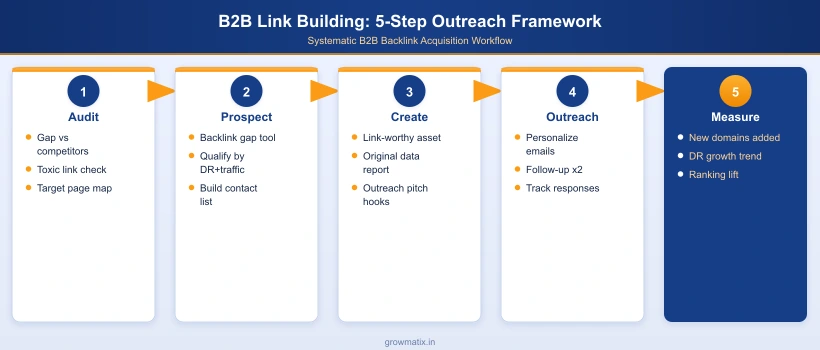
Consistent link acquisition requires a system, not a series of one-off campaigns. The difference between B2B brands that build 5 to 10 new referring domains per month versus those that earn 1 to 2 is almost always the presence or absence of a repeatable outreach process.
Prospecting: Finding the Right Link Targets
Prospecting begins with competitor backlink gap analysis. In Ahrefs or Semrush, identify the referring domains linking to your top three organic competitors that do not currently link to your domain. These are pre-qualified prospects: publishers who have already demonstrated willingness to link to content in your category.
Secondary prospecting sources include:
- Content Explorer searches: Search your primary topic keywords in Ahrefs Content Explorer, filtered to pages with DR 40+ and at least 500 monthly organic visits, sorted by linking domain count.
- Journalist query services: Platforms like Qwoted, SourceBottle, and Help a Reporter Out (HARO alternatives in 2026) surface journalist requests for expert commentary in real time.
- Industry roundup pages: “Best tools for [category]” and “Top resources for [topic]” pages are high-value targets because they exist specifically to link to relevant resources.
Personalized Outreach That Gets Replies
Personalization in B2B link building outreach means demonstrating specific knowledge of the target page and a clear reason why your resource improves it for the reader. Generic outreach templates, identifiable by opener phrases like “I recently came across your article on [topic] and loved it,” are filtered out by experienced editors and bloggers who receive dozens of similar emails daily.
An effective B2B outreach email contains four elements:
- Specific reference: Reference the exact paragraph, statistic, or section where your link would add value.
- Value framing: State clearly why the linked resource benefits the reader, not your brand.
- No-friction ask: Make the action request simple: “Would this be a useful addition?” rather than a lengthy justification.
- Clear sender identity: Link outreach from a named individual with a verifiable LinkedIn profile converts higher than outreach from generic company email addresses.
Pipeline Management and Follow-Up Cadence
Most positive responses to link outreach come from a second or third follow-up, not the initial email. A structured follow-up sequence matters: an automated or manually tracked sequence of two follow-ups at 5 and 10 days after initial contact captures a significant portion of responses that would otherwise be lost to inbox volume.
Track your link building pipeline in a simple spreadsheet or a dedicated tool (Pitchbox, Respona, or Hunter Campaigns): prospect domain, contact name, email, outreach date, follow-up dates, response status, and link status. Monthly reporting on prospects contacted, reply rate, placement rate, and new referring domains added gives program managers the data needed to identify which outreach approaches and content assets are driving results.
B2B Link Building Mistakes to Avoid in 2026
The following mistakes consistently undermine B2B link building programs, often invisibly until a Google penalty or plateau in organic growth makes the damage apparent.
- Buying links from link networks or broker services: Paid link placements from link farms and private blog networks remain detectable by Google’s spam systems and carry a penalty risk that can suppress organic rankings for months. The short-term ranking boost from paid links is not worth the long-term exposure.
- Anchor text over-optimization: Using exact-match commercial anchor text across the majority of your backlink profile triggers over-optimization signals. Maintain a natural anchor text distribution: a mix of brand name, URL, topical phrases, and naked URLs alongside occasional keyword-rich anchors.
- Pursuing link velocity over link quality: Earning 40 low-DR links in a month from irrelevant sites produces less ranking benefit than 4 editorial links from authoritative vertical publications. Speed is not the correct optimization target for B2B link building.
- Ignoring disavow maintenance: Toxic backlinks from previous SEO agencies or spam attacks can suppress rankings passively. Audit your backlink profile quarterly in Google Search Console and Ahrefs, and maintain an updated disavow file for confirmed spam domains.
- Orphaning linked pages from internal structure: A page with strong inbound links but no internal links pointing to it from other site pages does not distribute authority effectively. Every page earning external backlinks should be integrated into the site’s internal linking architecture.
- Confusing press release distribution with link building: Press releases distributed through wire services (PR Newswire, Business Wire) generate nofollow links on aggregator sites, not editorial dofollow links. They have brand visibility value but negligible direct link building value for SEO purposes.
Measuring B2B Link Building ROI
Connecting link building investment to business outcomes is one of the most persistent challenges in B2B SEO reporting. The lag between link acquisition and ranking improvement, and between ranking improvement and qualified lead generation, makes attribution harder than paid channel reporting. A structured approach to measuring SEO ROI provides the attribution framework and reporting cadence B2B marketing directors need to connect organic growth investment to pipeline.
Leading Indicators: Link Metrics to Track Monthly
- New referring domains added: The primary monthly health metric for any link building program. Track total referring domain count in Ahrefs or Semrush and measure net new domains added each month.
- Domain Rating or Domain Authority growth: A lagging indicator that validates referring domain quality. DR growth typically follows 4 to 8 weeks behind meaningful referring domain acquisition.
- Lost referring domains: Track domains that previously linked but no longer do. Persistent referring domain loss can offset acquisition gains and suppress authority growth.
Ranking and Traffic Metrics to Track Quarterly
- Target keyword position changes: Map your primary commercial keywords in Google Search Console and a rank tracker. Quarterly movement on these keywords is the clearest signal that link building is translating to ranking improvement.
- Organic click growth on target pages: Use Google Search Console’s Performance report to track impressions and clicks on pages receiving new backlinks. An increase in both metrics following a link acquisition campaign is a reliable attribution signal.
- Share of voice on cluster keywords: Track your brand’s share of page-one appearances across a defined keyword cluster in Semrush or Ahrefs. Link building should expand your cluster footprint over time.
Business Outcome Attribution
Connect organic performance to pipeline using GA4 conversion tracking on organic sessions. Tag key conversion events: demo requests, contact form submissions, and content downloads. Report on organic channel contribution to these conversion events monthly. For enterprise B2B sales cycles where lead-to-close may span 6 to 12 months, pair GA4 organic attribution with CRM data to surface deals where the first touch was an organic session on a page that received link building investment.
For B2B teams ready to build a systematic link acquisition program with measurable outcomes, our B2B SEO and link building services cover strategy, execution, and monthly attribution reporting across all major link building channels.